Help from Our Friends

“Then some people came, bringing to him a paralyzed man, carried by four of them. And when they could not bring him to Jesus because of the crowd, they removed the roof above him, and after having dug through it, they let down the mat on which the paralytic lay.” (Mark 2:3-4)

I had a very humbling experience last week that reminded me of the story from Mark’s Gospel about the paralyzed man brought to Jesus in a most unusual way. All three other Gospels contain a similar story where someone is carried to Jesus for healing, but only Mark has this most dramatic detail about the man’s friends being so committed and creative that they lowered him down to Jesus through a hole they dug in the roof.

Wouldn’t you love to hear the insurance adjuster’s response when the homeowner explains the hole in the roof with this story? My experience last week was far less dramatic but still very emotional for me.

The back story, no pun intended, is that because of chronic back pain and peripheral neuropathy I sometimes have a difficult time walking any distance. This is especially true after I’ve been sitting in a confined space, like an airplane seat, for any extended period of time. Last Wednesday my wife and I flew from Columbus, Ohio to Houston, Texas to visit family for the Thanksgiving holiday. The flight was delayed for 30-40 minutes while we sat on the tarmac in Columbus waiting for the pilots to arrive on another delayed flight from Houston. That made the total time on the plane around 3 hours.

Upon arriving at the Bush Intercontinental Airport in Houston we had a long walk (and a train ride) from Terminal E to baggage claim in Terminal C, and I was struggling to get there pulling a carry on and wearing a backpack. My dear wife offered to help with my luggage, but she already had plenty of her own; and I stubbornly kept pushing on.

By the time we got to Terminal C I was really tired and unsure how much further we had to go. We stopped to ask for directions from an airport employee who just happened to have an empty wheelchair, and he graciously offered me a ride. He was a life saver, and I was very grateful for his help. He not only pushed me to baggage claim, he took our claim tickets and got our luggage for us and then took us another good distance to where we could catch a shuttle to the car rental center. He even loaded our suitcases on the shuttle bus for us.

But here’s my problem. While I was very grateful for the assistance we received, I still felt helpless and frustrated that I needed that kind of help. I have not come close to mastering St. Paul’s advice in Philippians 4 to ”be content in whatever state I’m in.” I am reminded every time I look in the mirror that I am 77 years old, and if I forget, my aches and pains remind me of that fact; but I still try to deny it.

So I wonder how the paralytic man in the Gospel stories felt about his situation. We aren’t told why or how long he has been paralyzed. We don’t know if he asked these friends to take him to Jesus or if it was their idea. We don’t know how he felt about being carried up on the roof. That had to be little scary for him!

The truth is the story really isn’t about the paralytic, just as my wheelchair ride wasn’t really about me. The Gospel story is primarily about Jesus, and my story if I step back from my own pity party is really about the kind man who helped us. Yes, he was doing a job he is paid to do, but he did it with such kindness and grace that it was obviously more than just a job.

And Mark’s point in sharing this story in just the second chapter of his Gospel is not primarily about the paralytic but about the healing power of God and who Jesus is. We need to read the first chapter of Mark to realize how central that fact is. Mark wastes no time getting to the radical ministry of Jesus. In the very first chapter he includes four specific healing stories, including Simon’s mother-in-law, casting out many demons, a man with an unclean spirit, and a leper. He goes “throughout all Galilee,” and even though he tells them all not to tell about their healing by the time he returns to Capernaum even though there was no social media to promote his good works Mark tells us “the whole city” is crowding around to get to Jesus. He’s a bigger celeb than Taylor Swift.

But here’s the thing about the story in Mark 2; it’s not just another healing story. For the first time Mark tells us Jesus dares to forgive the paralytic’s sins, and that of course ticks off the Scribes who are nearby and take offense that Jesus dares to claim such divine authority. I love Jesus’ response to the Scribes. He basically says, “OK, to show you my power, how about I just say to the man ‘take up your bed and go home?’” Which of course the miraculously healed man does, and the crowd is amazed because “we have never seen anything like this.”

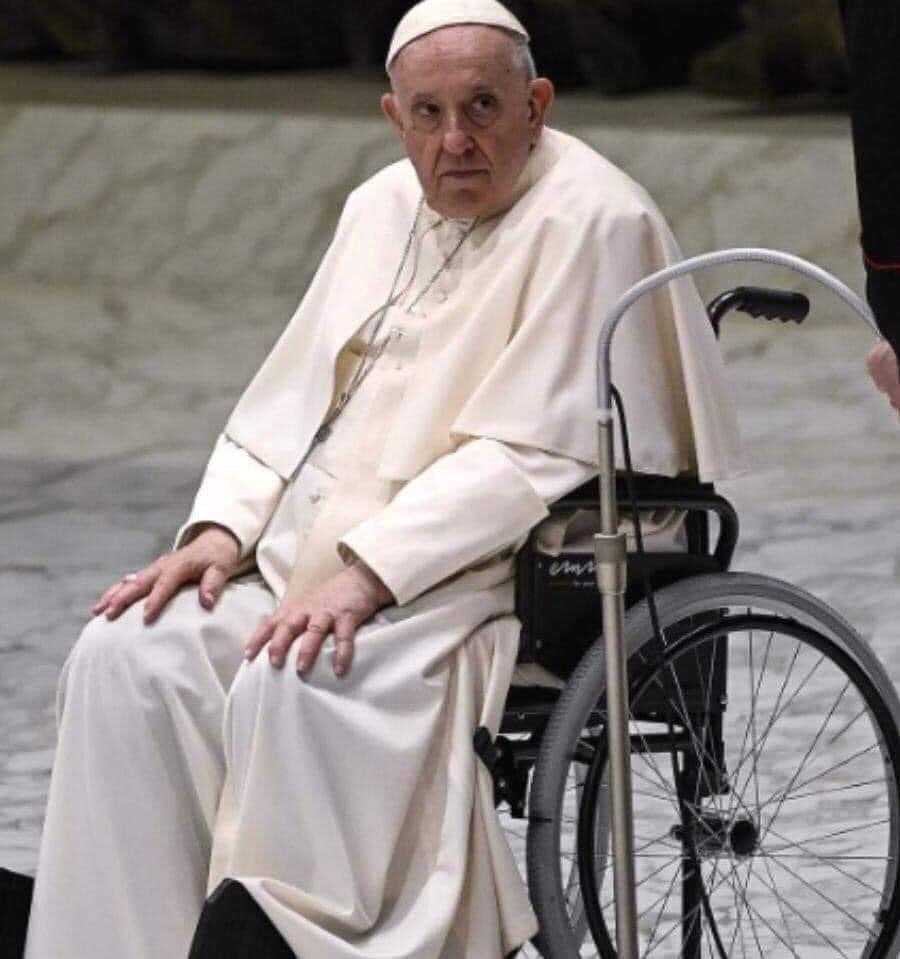
As I was thinking about all of this I came across this picture of Pope Francis, and it hit me again. My story like the paralytic’s story are not about the helpees but the Helper. If a great man like Pope Francis can accept the help of others who am I to think I am somehow better than that. The truth is we are all dependent on the help of others. It may be emotional support or sometimes physically taking us to the spiritual or physical help we need. It may be realizing we are dependent on the farmers, truckers, and grocers who get food on the shelf for us to purchase.

The secret to it all is being humble enough to recognize and ask for whatever help we happen to need at any given point in life. We all come into this life totally dependent on others to nurture, protect, and care for our needs for several years, and the cycle of life means that most of us will end up pretty much in the same need for caregivers at the end of this life. Our choice is how humbly and graciously we accept that care.

Where’s the Justice?

Election Day, praying for my tribe to win as much as possible even as I fear the dangerous person just elected Speaker of the House and the Trump circus in a New York court room. Trump has succeeded in taking the media spotlight off the mayhem in Gaza, but the slaughter continues there and elsewhere. A mass shooting in Cincinnati recently barely made the news.

We are having new skylights installed today while millions of people have no roof over their head at all. Where is the justice?

My privilege feels like a millstone tied around my neck, even while I resent working for hours on end the last two days to maintain our wonderful home.

I get wonderful medical care for my puny aches and pains while hospitals are bombed in Gaza. Where’s the justice?

I simply turn the tap and open the fridge whenever I thirst or hunger while millions of climate refugees and war victims around the world are starving and dying. Where’s the justice?

By accident of birth I am a privileged white male in a relatively safe and prosperous nation. My ease and comfort are as undeserved as the suffering of innocent Israelis and Palestinians and Ukrainians is unjustified. Where’s the justice?

If I thank God for providing so bountifully for me and my tribe anyone can see the irony that all these others of God’s children who pray to the same God still suffer so horribly. I am not some worthy saint being rewarded for my good behavior like a school boy getting gold stars for what we used to call “deportment.” If I am graded on keeping the 10 commandments or living by the Boy Scout Law I learned as a youth you better believe I hope God grades on the curve. Where’s the justice?

As we Christians paused ever so briefly this week to observe All Saints Day our grief and memories of those who have passed beyond this mortal coil are tied to the deaths of all those unknown to us but known to God souls lost in recent days to the madness of war. Nadia Bolz-Weber said it so well in her sermon for Sunday, “You’re going to die:”

“The untimely and unnecessary deaths of 10,000 children of God, many of whom are actual children, in just that one tiny area of our planet in one month’s time ripples out into an ocean of grief for the 100,000s of thousands who know their names…their babies, and brothers and wives and friends.

This is their day too.

So as we remember our own dead, may we feel connected to the sorrow of those who are also grieving today. And say as our lord did, Blessed are they who mourn. Blessed are they who have loved enough to know what loss feels like.”

I had never thought about grief as a blessing even though I have read those words from the Beatitudes dozens of times. “Blessed are those who mourn.” My thoughts always jump to the second half of that verse “for they shall be comforted.” Yes, we yearn for our own comfort and those of others. But there is no comfort without grief, just as there is no resurrection without death. So in one of those theological twists of fate there is gratitude even for pain. If we could not feel the pain of grief, even for people 10,000 miles away, we also could not feel love and appreciation for our privilege.

I do not deserve my comfortable life any more than the trapped citizens of Gaza deserve the horrors of modern warfare, any more than the 1400 Israelis deserved to die on October 7, or the 6,000,000 Jewish victims of the Holocaust, or the 3000 Americans deserved to die on 9/11. All of that reminds me that life itself is a privilege to be cherished and lived to its fullest no matter where we have landed by accident of birth on this fragile planet.

May our gratitude for what is take the wings of mercy to act as those who do justice here and now, who love mercy wherever we are planted, and through it all walk humbly and gratefully with the One who gives it all and who alone can fathom the mystery of life and death in our broken and unjust world.

Blinded by Logs and/or $ucce$$

I am still affected by the motto in my childhood home which said “If you can’t say something nice, don’t say anything at all.” But I am also a believer in what Jesus said about the truth setting us free. This post may or may not be a rant about the current state of our nation and world, and it may not be “nice;” so be forewarned.

The current extreme weather all over our country makes me wonder what more it will take before everyone can see that we and our planet are in deep do do? I just read an article about the ocean waters around Florida heating up much faster than usual this summer and threatening to kill the coral. Farmer’s Insurance is pulling out of Florida because of extreme weather threats. And what is the Governor of Florida doing to save his state? Nothing but trying to drag it back into the 19th century!! Are the fossil fuel felons of the world and the politicians they own so blinded by their wealth and profits that they can’t see the flooding in Vermont and the triple digit temperatures in the Southwest? Are they so deaf they can’t hear that the all time record for the earth’s temperatures have been broken multiple days in a row this month?

Meanwhile, in our nation’s capitol one football coach from a former Confederate state is single handedly weakening our military by holding up confirmation of hundreds of military officers because of his personal beliefs about reproductive rights. Who in the world wrote rules for the United States Senate that empower one senator out off 100 to hold the other 99 hostage?? How in God’s name is that even possible in a democratic government??

And across the pond Putin’s diabolical attack on Ukraine has now been committing war crimes for over 500 days. Yes, I’m glad NATO is stepping up and has recovered from Trump’s undermining of it, and that’s great; but at what cost in dollars and lives? And I don’t even want to think about the epidemic of gun violence in this country that just keeps getting worse. It is such a common occurrence now that mass shootings are not even headline news anymore. What in the world is the flaw in human nature that we cannot find ways to solve our differences without reverting to violence?

I had two short vacation trips recently where I visited historical sights that played key roles in American history. One was the Fort Pitt museum at the confluence of Pittsburgh’s three rivers. Being a strategic point in the 18th century for control of the land called the Northwest Territory the victory over the French at Fort Pitt is celebrated for securing the advancing settlement of that land by the British and the American pioneers who followed. The second place I visited was the Perry Monument in Lake Erie commemorating Commodore Perry’s victory over the British in the War of 1812. That victory secured American control of the Great Lakes and provided another critical commercial and settlement route into the Great Lakes region.

What struck me about both of those places was first that violence as usual was used to take control of desired territory, and second that almost no attention in the accounts offered in either place about these military victories paid any attention to the fact that there were Native Americans living on this land long before the Europeans arrived, and the might-makes-right doctrine of dominion trumped all other concerns that should be so obvious to an objective observer.

In all of these cases humans were and continue to be blinded to truth and justice by a political and economic system built on greed for power and wealth with no long-term concern for the consequences of our actions. How ironic in a country that calls itself “Christian” when the Christ we claim to follow said very clearly in the Sermon on the Mount that “You cannot serve God and wealth.” (Matthew 6:24)

I thought I would end there until it hit me like a foul ball lined into the stands—what my ancestors did to the people living here first is no different than what Putin is doing in Ukraine! My rant against the speck in Putin’s eye blinded me to the log in our own. I don’t know why I didn’t see that much earlier, but I didn’t. I need some time to sit with that, and it won’t be comfortable.

Holy Thursday Humility

I had a Martin Luther moment this morning.  No, I didn’t nail any theses to a church door.  It happened like this.  I had a busier than usual early morning for me, which means I was dressed and doing some slightly physical labor outside by 9 am.  Mornings are hard for me anytime.  My arthritic joints complain loudly when pressed into action too soon after I get up. 

All of that is to say that my outside chores required more exertion than they used to, and I managed to work up a sweat.  I hadn’t planned on showering this morning because I wanted to work out later in the day, but I had a PT appointment and wasn’t fit to go without a shower.  As I finished the shower I remembered the story that Martin Luther always reminded himself that he was baptized whenever he bathed.  At that moment I realized how fresh and renewed I felt.  It was like the warm water had had not only washed away the sweat and relaxed tight muscles, it wrapped me in the grace-filled water of baptism.

This being Holy/Maundy Thursday I had read two devotions earlier this morning about Jesus washing his disciples’ feet, including those of Judas.  The familiar story of Jesus overruling the objections of Peter who argued their roles should be reversed reminded me of Jesus’ own baptism where John makes a similar plea that Jesus should be the one doing the baptizing.

One of my favorite moments in the musical “Godspell” is the baptism scene.  When John asks Jesus what he’s doing there Jesus simply replies, “I came to get washed up.” And on this Holy Thursday I marvel anew at the integrity and consistency of Jesus’ ministry.  From baptism to foot washing he shows us the meaning and the power of humble servanthood.  He arrived in Jerusalem that Sunday not in a Lincoln limo, but in a beat up Volkswagen bug.  He came to show us in everything he did in the words of the great old hymn by Ernest W. Shurtleff (1887) that it is “not with swords loud clashing, or roll of stirring drums, but with deed of love and mercy the heavenly kingdom comes.” (From “Lead On, O God Eternal”)

Micah 6:8 is the verse I would pick from the whole Bible if I could only have one to describe the meaning of messianic living and what it means to take up a cross and follow Jesus.  Holy Week provides the whole story of Christian discipleship in a nutshell as Jesus shows us what God requires of those who would fulfill the human potential our creator has instilled from birth/baptism in all of us.  In those 6 days Jesus did justice, he lived mercifully, he did it all in humility, and like God the creator he rested on the Sabbath.  And then comes rebirth and a new creation early on Sunday morning. 

Ukraine: Reaping the Whirlwind and Beyond

“Those who have sown the wind will reap the whirlwind.” Hosea 8:7.

The prophet Hosea wrote those wise words over 2700 years ago predicting the fall of the Northern Kingdom of Israel to Assyria. The wind they had sown in that case was putting their trust in foreign alliances instead of God.

Fast forward to 2022 CE to a confrontation between Vladimir Putin and the western world.  The civilized world is appalled at the brutal and indiscriminate slaughter of innocent civilians by the Russian dictator. There are many legitimate arguments being made comparing this invasion to Hitler’s takeover of Eastern Europe 80 years ago.

President Biden and the NATO allies are very reluctant to confront Putin militarily or in any way that Putin might construe as an affront to his fragile ego. The comparison of this “inaction” to British Prime Minister Chamberlain’s failed appeasement of Hitler in the run up to World War II is somewhat persuasive, but there is one huge difference. Hitler didn’t have nukes. Putin does, lots of them, and he seems unhinged enough to use them.

In other words, we sowed the atomic wind on Hiroshima and Nagasaki 80 years ago and launched a suicidal arms race with the ever so apt strategy named MAD (mutually assured destruction). Now we are reaping the whirlwind of birthing the nuclear arms race. Our ability to stop Putin’s massacre of Ukrainians is hamstrung by the fear of the very nuclear arms race we invented.

I have no solution to this conundrum. Even though I try to be a pacifist, if there was a way to blow Putin to kingdom come without escalating this whole mess I’d be all for it. No one wants to ignite WW III because we know there will be no WW IV. In my darker days, and there are more and more lately, I am beginning to believe that between humanity’s obsession with violence and our greed that fuels climate change the human race is doomed.

But here’s the thing, that is not as hopeless or as fatalistic as it sounds. Because the God of the entire universe is so much more, well, cosmic than anything our puny little planet amounts to that the loss of this 3rd rock from the sun would barely be a blip on the cosmic screen. That is a harsh pill to swallow for those of us who think we are created in God’s image, a little less than the angels (Psalm 8:5)! Ever since Galileo and Copernicus dared to question the anthropocentric belief that the earth was the center of the universe our knowledge of the infinite nature of space has made us more and more humble, or should have.

I hope and pray I am wrong about the future of humankind. At my age it doesn’t really matter much to me personally, but it makes me sick to think of that bleak future I’m leaving to my kids and grandkids. Is there still hope for humans to learn to live in peace with one another? Could the threat of climate change provide motivation for humans to finally band together to fight a common foe instead of each other? Based on our past track record I don’t see it happening. If the Holocaust, Hiroshima, and Nagasaki didn’t cure our warring madness, what will?

[Note: This post originally ended right here, but about 5 minutes after I posted it I heard that still small voice saying, “That’s not the end of the story.” So I unposted it and added the following.]

Here’s the good news—the whirlwind doesn’t get the last word. The name “Hosea” means “salvation.” And even though Hosea proclaims Yahweh’s anger at Israel he also shares God’s compassionate nature for the Souther Kingdom, Judah.

“But I will have pity on the house of Judah, and I will save them by the Lord their God; (1:7a). But listen to the rest of that sentence: “I will not save them by bow, or by sword, or by war, or by horses, or by horsemen.”(7b). God’s salvation does not come by instruments of death and destruction. Those ways are anathema to the One who dreams of a day when swords are beaten into plowshares, spears into pruning hooks, and the ways of war are learned no more. (Isaiah 2:4)

The biblical narrative has rightly been called the salvation history of humankind. How many times do the chosen people break their covenant with God? How many times is Jerusalem leveled like one of the horrendous images we have from Ukraine? Pick a number, any number, say x. And whatever number we pick the answer to the next question, how many times does God redeem her people, is x + 1.

Even as he proclaims judgment on Israel’s unfaithfulness just three verses later Hosea assures his readers that the alienation and suffering is not the final word.

“Yet the number of the people of Israel shall be like the sand of the sea, which can be neither measured nor numbered; and in the place where it was said to them, “You are not my people,” it shall be said to them, “Children of the living God.” (Hosea 1:10)

What does this say to our broken, fearful world today? We know not when, where, how or even why God will forgive humankind’s unfaithfulness, but in God’s good time, not ours, it will be done. Even if we destroy ourselves and this precious earth God has entrusted into our care, we and all of creation will live and move and have our being eternally in the cosmic source of all Being. Because we put our trust, not in weapons of death and destruction, but in resurrection that assures us that nothing in all creation, “neither death, nor life, nor angels, nor rulers, nor things present, nor things to come, nor powers,nor height, nor depth, nor anything else in all creation, will be able to separate us from the love of God in Christ Jesus our Lord.” (Romans 8:38-39)

Amen

Rescue

Our church is doing a series of Advent devotions on words that reflect facets of the Advent and Christmas season. I wrote this one on the word “rescue.”

When I signed up for this word I was thinking about our granddaughter Olivia and the cat rescue organization she started last year. She named her rescue operation “Little Boo Rescue of Ohio” in honor of “Boo,” one of the first kittens she rescued who unfortunately was too sick to be saved.

The three cuties pictured here are Cherry, Mango and Honeydew. They along with their siblings, Apple and Bianca were near death when rescued, but thanks to a lot of TLC and excellent medical care all five are healthy again and looking for their forever homes. Olivia has always had a huge heart for our four-legged friends, and we are very proud of the work she and her colleagues are doing, all of which is over and above their full-time jobs.

Their rescue work often requires responding to calls from someone with a feral cat problem.  She and her friends respond by going out in the dark to capture cats so they can be neutered, vaccinated, and nursed back to health.  They are then either adopted or sent to foster homes.  It is a true labor of love.  

Such caring work reminds me of Jesus’ story of the shepherd who leaves the 99 sheep to go searching for the one lost stray.  We are all that lost one at some time in our lives, and we run and hide from God all too often.  But God never gives up and will be there to cuddle us back to health whenever we admit we need to be rescued.

We’ve all heard the joke about how hard it is to herd cats, and if she could I’m sure Olivia would transform herself into a cat so the lost ones would trust her and be easier to rescue. And that’s exactly what God did for us in the human baby born in Bethlehem so long ago. The incarnation means that God is with us no matter how many times we need to be rescued.

The Kindness of Strangers

“Now in Jerusalem by the Sheep Gate there is a pool, called in Hebrew Beth-zatha, which has five porticoes. In these lay many invalids—blind, lame, and paralyzed. One man was there who had been ill for thirty-eight years. When Jesus saw him lying there and knew that he had been there a long time, he said to him, “Do you want to be made well?” The sick man answered him, “Sir, I have no one to put me into the pool when the water is stirred up; and while I am making my way, someone else steps down ahead of me.” (John 5:2-7)

Our modern fast-paced living makes it easy for me to understand the apathy or selfishness of strangers that would jump in line and leave a sick man unhealed for 38 years. I have to admit I too often am so turned in on myself and my problems that I have done somethings like that. I apologize to anyone I’ve disrespected, even if I didn’t know I was doing it.

One way I try to change my negative thoughts and behaviors is to counter those painful memories by noticing the many acts of kindness that will never make the nightly news. One of my favorite personal memories of the kindness of strangers happened many years ago, 52 to be exact, when I was in New York City for the very first time. I was a young 23 year old who had lived a very sheltered small town life up to that point; so I was quite intimidated by the sights and sounds of the big city.

It was the end of a five-city tour I took with some fellow United Methodist seminarians. We had toured United Methodist boards and agencies as a group; so all of our transportation and hotel needs had been taken care of by the trip leaders. But now at the end of the trip we were all on our own to get to one of the New York airports for our flights home. So the two of us from Methesco (the Methodist Theological School in Ohio) set out from our hotel in Harlem for JFK airport. My traveling partner was an equally inexperienced traveler, and remember this was 1969, way before cell phones and gps that we rely totally upon these days to help us navigate strange places.

Carrying our luggage (in those days before roller bags), craning our necks to read street signs we undoubtedly looked as lost as we felt. We had grown up hearing and fearing how impersonal city folk were, but that day time after time strangers came up to us without being asked and offered to help us get on the right subway or bus. Without their help I doubt we would have made it to JFK in time for our flight.

And even as I write this I remember a very similar experience some 40 years later when my wife and I were in Tokyo trying to figure out which train to take toward downtown. We were about to board one going the wrong way when a kind Japanese gentleman noticed our indecision and not only told us how to get to the other side of the train platform and on the right train, he actually walked with us to make sure we did it right.

Such acts of kindness from strangers unfortunately was not the experience of the man in the text from John. Many years ago I heard the late Fred Craddock preach on this text. He explained the story this way: he said that the reason the man couldn’t get into the pool fast enough to be healed was because people with hang nails, skinned elbows and runny noses were quite mobile and always got into the pool first.

I was reminded of that story when we were flying home from a family Thanksgiving Friday night. Because of my bad back and balance issues due to neuropathy handling luggage when we travel has become a huge challenge for me, especially when other people are waiting behind us in the plane’s aisle during boarding and deplaning. So we have tried to mitigate that problem a bit on recent trips by staying in our seats while others exit the plane so we aren’t blocking the aisle and inconveniencing others. We did that Friday night when we arrived back home in Columbus, and most people were off the plane when a nice young man stopped to ask if he could get our bags out of the overhead bins for us.

For far too long I have been in the habit of declining such help because my pride made it hard to accept that I am officially old and really do need help. But this time I was simply grateful for this young man’s help. He was so much stronger and taller than I that he made handling our luggage look so easy, and it only took a few seconds for him to do what would have taken my wife and I so much longer. Yes, I hate not being more self-sufficient, but mostly I am just humbled by the kindness of strangers and vow to pay that forward more often when I can.

For the record, here’s how the story in John ends: “Jesus said to him, “Stand up, take your mat and walk.” At once the man was made well, and he took up his mat and began to walk.“ (John 5:8-9)

No, I can’t heal people like Jesus did, and I will not be lifting 40 lb. suitcases anytime soon; but there are plenty of things we can all do for others if we aren’t rushing to beat them into the pool or the best parking place. It costs nothing to treat servers or store clerks or random strangers with kindness; so let’s do it. We will never know what a difference it might make in someone else’s life, but we will know the joy of human connection.

Being Real

I do not know what the average life expectancy is for snow persons, but we have one in our front yard, thanks to my wife Diana, who has lasted longer than any I can remember in our fickle Ohio weather.

It’s not been an easy two weeks for our Frosty. The constant cold temps have kept him from melting, but the sub-freezing has turned him into solid ice. That makes him very sturdy, but it has also meant that when his nose and hands fell off they could not be reimplanted.

Frosty’s noseless, handless condition and his loss of some of his buttons reminded me of one of my favorite children’s stories, “The Velveteen Rabbit,” by Marjorie Williams Bianco. For me the best part of the story is a discussion between two toys in a boy’s nursery, the skin horse and the velveteen rabbit, about what it means to be “real.” Here’s their dialogue:

“What is REAL?” asked the Rabbit one day, when they were lying side by side near the nursery fender, before Nana came to tidy the room. “Does it mean having things that buzz inside you and a stick-out handle?”

“Real isn’t how you are made,” said the Skin Horse. “It’s a thing that happens to you. When a child loves you for a long, long time, not just to play with, but REALLY loves you, then you become Real.”

Does it hurt?” asked the Rabbit.

“Sometimes,” said the Skin Horse, for he was always truthful. “When you are Real you don’t mind being hurt.”

Does it happen all at once, like being wound up,” he asked, “or bit by bit?”

“It doesn’t happen all at once,” said the Skin Horse. “You become. It takes a long time. That’s why it doesn’t happen often to people who break easily, or have sharp edges, or who have to be carefully kept.

Generally, by the time you are Real, most of your hair has been loved off, and your eyes drop out and you get loose in the joints and very shabby. But these things don’t matter at all, because once you are Real you can’t be ugly, except to people who don’t understand.”

One can learn a lot from stuffed toys and snow persons.

Simple Things that Heal

“Father, if the prophet had commanded you to do something difficult, would you not have done it? How much more, when all he said to you was, ‘Wash, and be clean’?” (2 Kings 5:13)

That verse is from the wonderful story of the healing of a Syrian military commander named Naaman.  You can read the whole story in 2 Kings 5, but here’s the abridged version.  Naaman comes down with a dreaded case of leprosy, the grossest curse of biblical times.  But in Naaman’s household is a political prisoner captured in Israel.  The slave girl is Naaman’s wife’s servant.  This nameless girl overhears Naaman whining about his plight and tells him there is a prophet in Israel who can heal him of his leprosy.  Even though this referral comes from an anonymous and powerless slave girl, i.e. someone on the very bottom rung of the cultural ladder, Naaman assumes such healing can only come from an important and powerful ruler.  So he sends a letter to the King of Israel who freaks out assuming this is some kind of political trick to make him look bad.

And then the prophet Elisha hears about the King’s dilemma and says, “Send him to me.”  Naaman shows up at Elisha’s house and gets all upset because Elisha doesn’t even come out to greet him.  He just sends a messenger out who tells Naaman to go wash in the Jordan River 7 times.  Naaman balks at this because he was expecting Elisha to come out and stage a spectacular miracle healing, and besides they have better rivers in Syria where he could have washed without making this long journey.  He is ready to go off in a huff, unhealed, but his servants (note how the least powerful characters in this drama are again the wise ones) deliver the line at the beginning of this post.  And reluctantly Naaman listens to reason, washes in the Jordan and is cured.  

Naaman’s story came to my mind in the midst of this pandemic because like Naaman all of us are being asked to do very simple things that require no special skills or knowledge.  We can all wear a mask and stay a distance from each other, and yet for different reasons masses of Americans refuse to do the only things we can do to combat this virus that has already killed over 225,000 Americans.  

Will we listen to those wise enough now who are saying to us, “Hey, if you had to do some super heroic deed to stop the spread of this deadly disease, wouldn’t you do it?  So how much more should we do the simple things.”

Naaman came to his senses and was humble enough that he listened to his servants and was healed,  Give us ears, O God, to hear and heed the simple things we can do to be restored to health.  

A Prayer for Coming Home

Gracious and loving God, this prodigal child is coming home. I’ve been awaymuch too long. I can’t believe the welcome mat is still out after how poorly I’ve treated you. I’ve been lost in the wilderness, depressed, frightened and angry that life isn’t fair.

I’ve taken detours through doubt and lingered too long in places of sin. I lost my way in anger and self-pity, afraid to come home and not even sure I any longer knew the way.

The simple faith of childhood failed me in times of greatest need. I surrendered to to the demons of temptation that led me down the dead end paths of prosperity, power and fleeting pleasures of the flesh.

I knew better. I had been taught your Word from childhood, but rebellion against the bonds of legalism alienated me from my roots and my heritage. When once I felt closely held by your loving arms I grasped now only air when I reached out to you. My prayers for your help grew empty and hollow because I heard no answers, probably because I never stopped the pursuit of happiness long enough to listen for your reply. My vision was clouded by tears of frustration and fear; so I could not even see you in the beauty of creation. And I certainly couldn’t see you in the chaos and injustice in our world. I gave up trying to find you.

I drank deeply of the great American myth of individualism. I succeeded so well at school and work that i never learned the lessons that failure alone can teach. When things became to challenging rather than fail I simply quit. I gave up on relationships and career goals instead of doing the hard work of trying multiple ways to solve a problem. I played it safe rather than risk taking unpopular stands on social justice issues. I took the wide path that leads to destruction.

But now I’m coming home. I humbly throw myself on your mercy, trusting that you will catch me and hold me close, hold me until my fear gives way to peace. I’m coming home, not for a fatted calf, but hoping your Holy Spirit will ignite the fire of faith in me anew and send me out to invite other lost ones longing to come home but are too afraid and ashamed.

In the name of the one who overcame Satan’s temptation in his wilderness time. Amen