Steve Harsh, Ph.D., M.Div., is a pastor, teacher, and writer who uses the creative power of narrative to promote moral and faith development as the foundation of his preaching and teaching. Steve has been a pastor to six United Methodist congregations, been the Director of The Interprofessional Commission of Ohio, and taught preaching for twenty years as an Adjunct Professor at the Methodist Theological School in Ohio. He currently serves as a part-time preaching pastor at Northwest UMC in Columbus, Ohio. Steve lives with his wife Diana near Columbus, Ohio. Steve published his first book in 2011, Building Peace from the Inside Out: Stories for Peace Seekers and Peace Makers." It is available from lulu.com
From my pastor, Chris Rinker: “Giving up something is not punishment but making a space for God to create something new in us.” He followed that with a question I will be pondering for awhile: “What can I do or not do for Lent that will make space for God in my life?”
I read this one from a fellow pastor in a Facebook group responding to a question about what words to use while imposing ashes. I’m sorry I don’t remember his name, but his words have stuck with me. He suggested saying “You are dust, but remember what God can do with dust!”
That got me thinking. We are dust of the earth but also star dust spewed forth billions of years ago by the Big Bang that is still creating and expanding God’s universe. Ash Wednesday is a reminder to accept our mortality so we, like Buzz Lightyear, can leap into the future and go to “infinity and beyond.” We chuckle at a Disney toy making that kind of foolish leap, but on the days we believe** we know that it is exactly what we are called to do—to trust without fear, even when the foundations of our world are shaken by rockets and bombs; even when we fear what a madman with nuclear weapons could do to life as we know it; even when we fear that human kind is hell bent on destroying Mother Earth with our pursuits of greed and power.
To trust God in such a time as this is to surrender all that we rely upon to give us security—all of that earthly stuff because to quote Kerry Livgren of the rock band Kansas, “all we are is dust in the wind.” But that wind is the Holy Spirit/Wind that breathes life into dust, that shapes star dust into us who are, on the days we believe and on those we don’t, truly created in the image of Being itself. Our current form goes from dust to dust, but our essence, our being is eternal. When this mortal life is over we trust that we will be forever in the heart of God who is love itself. Amen
** “On the days we believe” is a phrase I have adopted from Rachel Held Evans’ book “Wholehearted Faith” where she dares to write what I have often been afraid to say out loud. I will be forever grateful to her for her gift of honest vulnerability and helping me claim that I too have good days when I believe and many others when I’m really not sure.
O My God, the long anticipated and feared war in Ukraine seems to have finally begun. What a sad thing it is that humankind cannot give up it’s addiction to violence. Why do we keep doing the very things we know we ought not do? Why do we insist on labeling some of our sisters and brothers our enemies? My heart is broken that again we have turned our backs not only on lessons we should have learned from centuries of history but also again on your will for peace and justice for all of your children.
And my heart is laden down with regrets and feelings of futility. What can this old tired and retired preacher say or do that I have not done for decades? Did we not learn anything from the other two bloody wars in Europe in just over 100 years ago? How can partisan blinders keep so many American leaders from seeing that Putin is reprising Hitler’s playbook? How can support for Putin from an American former president not be treason? How can I love these enemies foreign and domestic when I want to damn them all?
I’m wrestling with a desire to speak out but fear the political backlash I may get from family and friends who want to keep me in the straight jacket of an apolitical and irrelevant pastoral stereotype? Is not your heart also breaking, loving one? Has it not been broken too many times to count since Cain killed Abel? Massacres, crusades and genocides often waged in your holy name have filled whole chapters of human history. We build monuments and deify military and violent heroes, but we crucify and assassinate messengers of peace. How in your name, O God, can we keep our faith when the forces of evil and darkness seem to be gaining thousands of blind followers each and ever day?
The Christian season of repentance is coming in just a week. Please may we celebrate a solemn and holy Lent this year and call upon the power of your Holy Spirit, the one force stronger than violence and human evil, to save us from our own sinful ways. Christ have mercy! Amen
“Swimming is the trifecta for me – exercise, meditation and alone time.” Brene Brown, “Atlas of the Heart,” p. 18
I had been thinking the same thing about swimming lately, and it was so good to have those feelings affirmed by someone whose work I admire so much. As some of you know I took up swimming as my primary form of exercise about a year ago. It happened almost accidently when I began doing some of my physical therapy for recovery from back surgery in the water. One of the blessings of the pandemic is that our YMCA’s began letting people reserve a lane in the pool to control numbers of swimmers and maintain social distance. The reservations are for 45 minutes; so the first time I went to the pool it only took me 15 minutes to do my PT exercises, and I still had 30 minutes left in my allotted time in the pool. So I decided I might as well see if I could swim a few laps – with the emphasis on “a few.”
That first time I managed 3 laps before I was exhausted. I have never been a strong swimmer. When I was in Boy Scouts many decades ago I needed to earn merit badges in both swimming and lifesaving in my pursuit of becoming an Eagle Scout. I passed both of those, but just barely. I was literally a 98 pound weakling in those days and also had a very hard time passing the requirement for running ¾ of a mile in under 6 minutes. My 13 year-old self would never believe that as a 40 something I could actually run 5 miles in 37.5 minutes; nor would he believe that I can now swim 900 yards in less than 45 minutes.
Because of several health concerns swimming is the ideal low-impact aerobic exercise for me. And over the last 12 months I have not only increased my endurance but have come to truly enjoy swimming. Dr. Brown captures some of the reason for that when she says, “When I’m swimming laps you can’t call me or talk to me, it’s just me and the black stripe.” As an introvert I need solitude, and especially since I got a new mask and snorkel and can actually do most of my laps under water where I can’t see or hear anything that solitude has been like icing on the cake.
Even though I was a fairly serious runner for 25 years I never experienced what others describe as the “runner’s high.” Running was always work for me, I think in part because I ran most when I was going through some particularly rough patches in my personal, professional, and married life. I wasn’t running for fun but literally running away from problems I didn’t know how to handle. But I realized today as I set a personal record of 900 yards that I am feeling a swimmer’s high. The water supports me, relieving pressure on my joints, and I truly felt like I could have gone much further today. Today I was in a pool that does not reserve lanes; so I had no time limit on how long I swam. I enjoy being in the pool so much now that I can even do it without resistance or hesitation even on very cold winter days.
The meditation aspect of swimming has taken the form for me of repeating a couple of mantras that resonate with where I am now in my faith journey. Those phrases include several Hebrew and Greek words for God (Yahweh, Elohim, and Abba), spirit (ruach), justice (mishpat), and love (agape). I hope my seminary professors will forgive me for my awkward combinations of several languages, but my current mantras are: Ruach Abba, Ruach Elohim, and Yahweh Mishpat. I especially like using “Abba or Daddy” for God as Jesus did because my other inspiration for swimming is remembering the 12 frightening hours my dad spent in the cold North Atlantic waiting to be rescued from the crash of his B-17 at the end of WWII.
Everyone needs to experiment and find what works for you, and that can change as we change. Today I added a new combination inspired by our congregation singing “We Are Called” in worship yesterday. That hymn is based on my very favorite summary of faithful living in Micah 6:8; so I swam several laps today repeating “Do Mishpat, love Agape, and swim humbly with Abba.” I have had trouble creating a regular meditation practice on land—too many distractions, but in water, which has so many theological conotations for me, I feel especially focused, close to, and sustained by the mystery we call God.
“The Godhead deserves our attention, and we approach and honor it through silence more than through words.” This quote from Meister Eckhart was in my devotions this morning from Christian Mystics, by Matthew Fox. It is devotion #134 of 365, and it really hit home today. I posted a piece in my blog yesterday afternoon on “Respectful Disagreement” and a short time later got a notice from WordPress, my blog platform that I have never seen before. It simply said that my blog stats were taking off. I looked up the stats and was amazed that there had been 48 views of that piece in just an hour. And the hits just kept coming all day! There were 130 views by days end and another 29 this morning, far more in 24 hours than anything I’ve written in 11 years of blogging.
I’m quite sure that it is not my writing but the urgency of the topic that is attracting the attention. There are obviously a lot of people feeling the need for respectful disagreement, and God knows we should be. But all that aside I could not help from feeling pretty proud of myself. And along comes God speaking thru Meister Eckhart and Matthew Fox to put me in my place yet again.
Here’s the full quote from Eckhart –
“God is a being beyond being and a nothingness beyond being. The most beautiful thing which a person can say about God would be for that person to remain silent from the wisdom of an inner wealth. So, be silent and quit flapping your gums about God.”
That smarts for a preacher and writer who has spent the last 53 years talking about God. It reminds me of hearing somewhere that trying to talk about God is like biting a wall. Words as inadequate as they are remain the primary tool we use to try and communicate the uncommunicable mysteries of existence.
Of course here I am still trying to capture the uncapturable with my puny words instead of just shutting up and living in mystery. Silence and surrender are just so uncomfortable that I cannot tolerate them for long. I know I will write about this again soon, but OK, God, for now I will be still and know what I cannot “know.”
Like many wiser minds I have been very troubled about the state of our nation and the world in general. In particular I’m most concerned about the chasm of polarization that seems hopelessly wide and deep, making any productive discourse almost impossible. This impasse is a huge impediment to resolving everything from American culture wars to Vladimir Putin waiting to pounce on Ukraine.
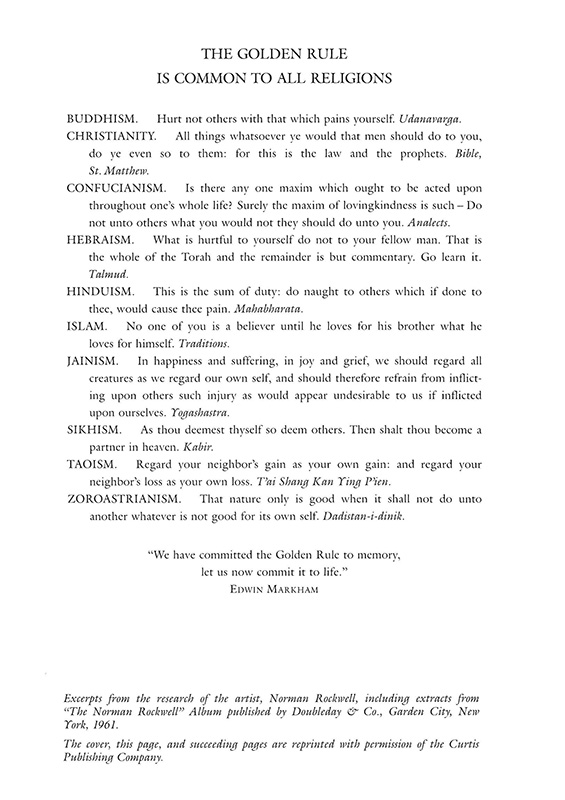
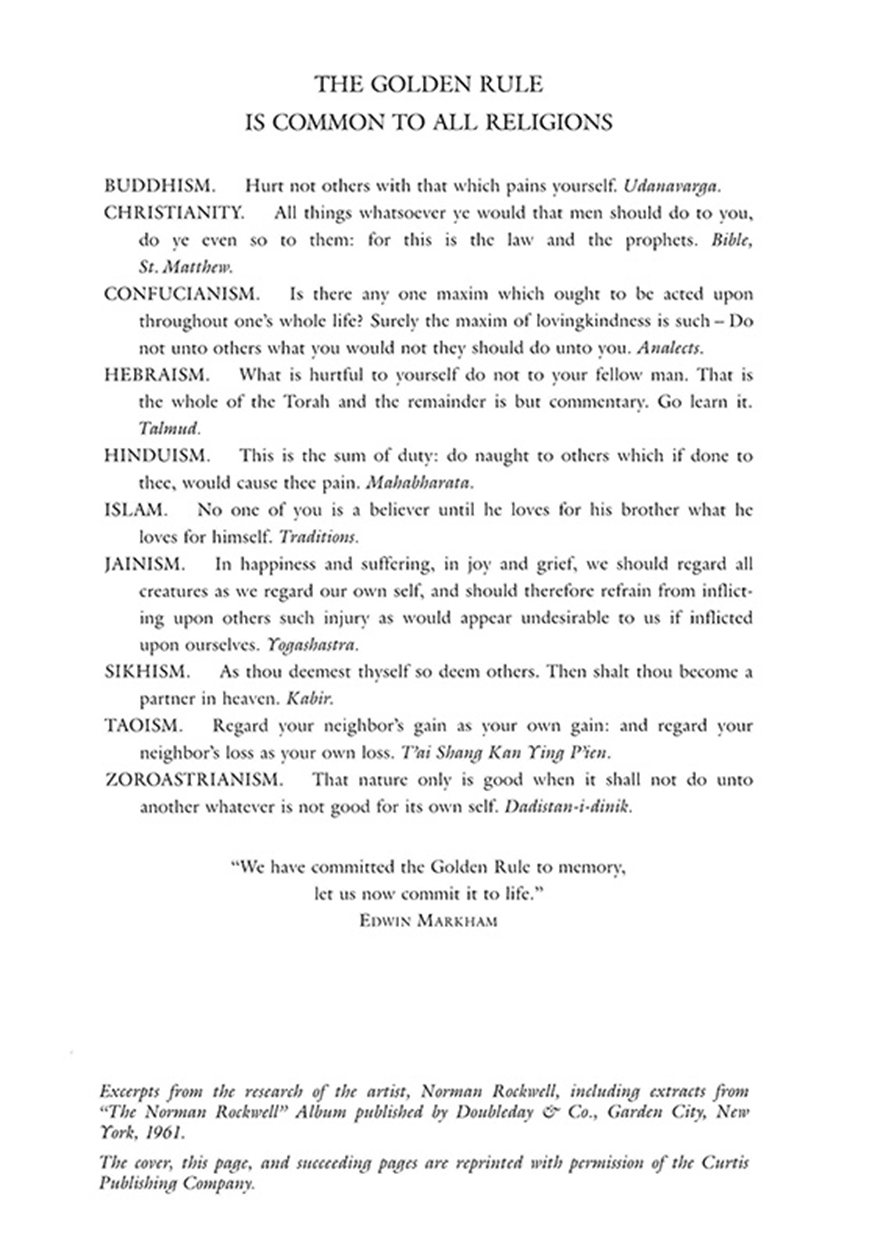
It may seem naive or trite, but what the Judeo-Christian world knows as “The Golden Rule,” “Do unto others as you would have them do unto you,” seems like such a simple solution to most of the world’s problems. Knowing that words similar to Matthew 7:12 or Leviticus 19:18 appear in other world religions I googled that phrase and, please excuse the pun, I struck gold on my first try. Here’s what I found:
The Saturday Evening Post: cover, April 1, 1961 was a Rockwell collage of a group of people of different religions, races and ethnicity as the backdrop for the inscription “Do Unto Other As You Would Have Them Do Unto You.” Rockwell was a compassionate man, and this simple phrase reflected his philosophy. “I’d been reading up on comparative religion. The thing is that all major religions have the Golden Rule in Common. ‘Do unto others as you would have them do unto you.’ Not always the same words but the same meaning.” – Norman Rockwell
Here are Norman Rockwell’s notes on the way that the Golden Rule is expressed in different religions…
Such a list is an example of what some contemporary theologians (e.g. Richard Rohr, Matthew Fox) would call cosmic or deep ecumenism.
All of that is wonderful wisdom, but I want to share with you a concrete example, a snapshot in time if you will, of what that kind of mutual respect looks like in action. In response to my blog entitled “Leading with Your Head,” (Jan. 30, 2022) I received this comment from a friend and colleague, Rev. Phyllis Fetzer. She wrote,
“Hi, Steve, I enjoyed this blog post and thank you for the reminder re: being holistic and not just “leading with our head.” I mean no disrespect when I point out two things about your digression re: traumatic brain injury suffered by (football) players: (1) It’s not a “maybe;” it’s almost a certainty that players will experience damage to the brain. One recent (respected) study showed traumatic brain injury in 110 out of 111 players; that’s basically 100%. (2) May I gently point out to you (and hope that you would do the same to me) that having a lifelong habit of watching football doesn’t mean that that habit can’t change, right? Thinking of other ethical areas where people have said, “I just can’t change because it’s been this way my whole life.” E.g., men referring to women as “girls”. We *can* change in light of new learning, yes? I hope and think that you know that I respect you very much, and am also aware that I’m sure that I have (an) ethical blind spot(s) in some other area. Thanks for the good post.”
Wouldn’t the world be a much kinder and more productive and loving place if we could learn or relearn to disagree constructively and respectfully. I can tell you I certainly receive that kind of feedback with open arms and an open mind rather than putting up my defenses when I feel attacked. And I hope I have learned to live by that old golden rule just a little more thanks to Phyllis.
“Words alone are cheap. Breathing deeply is required also. Connecting to the heart, not just the eyes. Meditation, mindfulness, contemplation, art and creativity–accessing the right hemisphere of our brain, not just the verbal hemisphere, is needed.
Incorporating and honoring our bodies, breathing deeply, not just leading with our heads. The heart after all resides in the body and disperses its blood and values from that center. And breath is the same word as “spirit” in many languages (including Biblical ones).”
Yes, words are cheap, but they are all we have to express our thoughts and feelings. That quote is from Matthew Fox in his “Daily Meditations” for today, (January 29). The phrase that jumps off the page for me is “not just leading with our heads.” We know with our heads and hearts that we are holistic beings and certainly not the Cartesian model of rational-logical critters who only exist because we think. We also feel and act.
I first really understood that in graduate school working on my doctorate in rhetoric. It wasn’t until then that I learned that the traditional three-part sermons I grew up with were originally not just three sections of a sermon linked together more or less successfully. The three point idea originated clear back in the 4th century BCE with Aristotle. In his classic “Rhetoric” Aristotle describes a holistic approach to persuasive discourse that appeals to “logos, pathos, and ethos,” terms best translated into English as “reason, emotion, and ethics.” Effective persuasion needs all three elements because humans are rational, emotional and ethical beings. The latter term applies to our behavior that is shaped by our reason and emotion.
Western philosophy and education have majored ever since Descartes in developing and teaching that primarily addresses the mind to the detriment of emotional and ethical development. In other words as in the quote I began with we “lead with our heads.”
As I was writing this piece I saw a very timely post on Facebook that seems relevant. I can’t verify the source from a Facebook called “Compass,” but it certainly fits my life experience as one who led with my head through twelve plus years of higher education. Here are the key points of the post:
“According to Psychologists, there are four types of Intelligence:
1) Intelligence Quotient (IQ)
2) Emotional Quotient (EQ)
3) Social Quotient (SQ)
4) Adversity Quotient (AQ)
1. Intelligence Quotient (IQ): this is the measure of your level of comprehension. You need IQ to solve math, memorize things, and recall lessons.
2. Emotional Quotient (EQ): this is the measure of your ability to maintain peace with others, keep to time, be responsible, be honest, respect boundaries, be humble, genuine and considerate.
3. Social Quotient (SQ): this is the measure of your ability to build a network of friends and maintain it over a long period of time.
People that have higher EQ and SQ tend to go further in life than those with a high IQ but low EQ and SQ. Most schools capitalize on improving IQ levels while EQ and SQ are played down.
A man of high IQ can end up being employed by a man of high EQ and SQ even though he has an average IQ.
Your EQ represents your Character, while your SQ represents your Charisma. Give in to habits that will improve these three Qs, especially your EQ and SQ.
Now there is a 4th one, a new paradigm:
4. The Adversity Quotient (AQ): The measure of your ability to go through a rough patch in life, and come out of it without losing your mind.”
The phrase “leading with your head” reminded me of something I’ve been concerned about as I have watched way too much football in recent weeks. Last weekend was an especially exciting one for National Football League fans. There were four playoff games last weekend that were all as closely matched as mathematically possible. Three ended with winning field goals as time expired and the fourth game went to overtime.
First a confession and/or disclaimer: I know the game of American football has become dangerously violent. Players are bigger, faster and stronger than they used to be, and therefore bodies collide with much greater force. Padding and helmets are certainly much better than the days of leather helmets, but we still know many former players are suffering from traumatic brain injury, dementia, and Chronic traumatic encephalopathy (CTE) because of their years playing football. Knowing all that makes me uncomfortable watching, but it’s something I’ve been doing for nearly 70 years and is a very hard habit to break. I also think the way football has replaced our former much more civil national pastime (baseball) is another sign of the toxic masculinity that I wrote about plaguing the American psyche that I wrote about last week.
But I digress a bit. What I noticed watching so many games last weekend was a troubling difference between college and professional football. The college game has a rule against “targeting” which is aimed to limit hits to the head and neck area and crashing into an opposing player with the crown of the helmet. That rule is designed to protect both the player on the receiving end of the targeting and the cranium of the deliverer of the blow.
Yes, targeting is a judgment call that referees spend much time reviewing replays before enforcing. They take it very seriously because the penalty for targeting is ejection from the game, and that has and will cut down some on the most dangerous hits in an inherently violent game. I think the NFL needs to do something similar to prevent more life-threatening injuries from “leading with one’s head.”
I offer that football reflection as a metaphor for the rest of us in real life. When we lead with our heads, divorced from understanding the emotional, social, and I would add spiritual aspects that are co-partners with the head in human beings we are failing to maximize a healthy comprehension of human behavior. We are not just rational/thinking beings. The various components of our humanity need to work in partnership with each other or we are not living up to our potential. And the huge existential problems facing the human race will not be solved if we are not playing with a full deck.
“They shall beat their swords into plowshares, and their spears into pruning hooks; nation shall not lift up sword against nation, neither shall they learn war any more.” Isaiah 2:4
“Blessed are the meek for they shall inherit the earth. “ Jesus, Matthew 5:5
Are Isaiah, Jesus and pacifists simply naïve optimists, or are they visionaries making a theological statement and not an historical one, a warning more than a prediction? By worldly standards such comments by Jesus are not taken seriously because most of us cannot begin to entertain the notion, let alone understand, that meekness and vulnerability can be and are the ultimate signs of strength.
Three of my favorite authors, namely Matthew Fox, Richard Rohr, and Brene Brown have addressed the important topic of toxic masculinity in their recent writings, and those words could not be more timely and critical. Toxic masculinity is nothing new, but seems to be as rampant and contagious as the Omicron variant of Covid. The standoff over Ukraine, the January 6 insurrection, the epidemic of gun violence in our cities, violent conflicts over masks on airplanes, and the populist posturing of Donald Trump and his merry band of followers are just a few examples from today’s headlines caused by the “might makes right” way of life.
My wife and I went to see the new “West Side Story” movie last weekend, and as you probably know the whole plot of the movie centers on gang violence and turf wars between the Sharks and the Jets. I knew that of course going in to the theater, but this version of that story seems to make the violence and tragedy more realistic and painful than the 1961 version. Or maybe it’s just that I know a lot more about the futility of violence now than I did when watching the original movie through the rose-colored glasses of my youth.
For my 15 year-old self West Side Story was just a tragic love story. I didn’t notice anything in the film about racism or social injustice because I knew nothing about racism or pacifism. I grew up in a pure white community playing cowboys and Indians and war games with my neighbor Jim Shockey. When I couldn’t be outside my bedroom floor was often covered with little army men on the floor (our video game violence then). My life ambition as a 4th grader was to be a marine and I dreamed of attending one of the military academies. My worldview was so narrow that I had no contact with any people of color until I was 20 years old.
Since West Side Story is more than 60 years old I don’t think I’m giving away any secrets when I say the movie’s tragic ending is a perfect and very moving depiction of how absurd and futile trying to solve conflicts through violence is.
Toxic masculinity is as old as the Genesis 4 story of Cain killing his brother Able. And in all the millennia since we have made almost no progress at learning to beat our swords into useful implements of peace. The statue depicting that verse from Isaiah that stands in front of United Nations Headquarters in New York City was erected just three years after the Holocaust, Hiroshima, Nagasaki and all the other horrors of World War II ended. Hitler and Mussolini and Emperor Hirohito were defeated through force the likes of which the world had ever seen.
The world had been naive or gullible enough to believe WW I as “the war to end all wars,” but only 20 years after the Treaty of Versailles ended that war the sequel debuted with Nazi Germany’s invasion of Poland! Sound familiar? I do not mean to cast any dispersion on those who joined forces to oppose the Axis armies. My father was part of that greatest generation who risked and/or lost their lives to stop the evil personified in Hitler.
Force was met with greater force, but to what end? History continues to repeat itself. Hitler and Mussolini are replaced almost immediately by Stalin, the Kim Un gang, Pol Pot, Mao, and the brothers Castro just to name a few 20th century despots.
We have cold and hot wars, guerrilla and urban warfare almost continuously all over the planet. We have spent obscene amounts of money on deadlier and deadlier weapons of mass destruction, and greedy American capitalists lead the world in profiteering from making and selling those killing machines.
How long will the human race pursue this madness? Until we destroy ourselves and the planet we live on? One can certainly offer plenty of evidence that our systems of patriarchy have failed to produce a world where we don’t learn war anymore. I still hope that the emergence of more women in important leadership roles will help diffuse the toxic love of violence and force that has been the human race’s taken-for-granted business as usual for millennia. But my hope is seriously tempered by the likes of Marjorie Taylor Greene and Lauren Boebert who are just as power hungry, paranoid and militant as their male counterparts.
This is not just a gender issue; it is a moral and existential threat to the human race itself, and it must change because there will be no WW IV. The U.S. 2022 defense budget is $700,000,000,000, and have you ever heard of any great debates in Congress about passing it? We have huge partisan wrangling over what we spend on education, the arts, health care and other social programs which cost a small fraction of the defense budget. The best way to start beating our swords into plowshares is to simply stop making bigger and more deadly swords and spears! We have enough atomic fire power to destroy the world dozens of times over. Why do we need more and more?
Another example of toxic versus heathy masculinity can be seen by comparing these two statements: 1) “Happy is the one who seizes your enemy’s infants and dashes them against the rocks.” 2) “You have heard that it was said, ‘An eye for an eye and a tooth for a tooth.’ But I say to you, Do not resist an evildoer. But if anyone strikes you on the right cheek, turn the other also; and if anyone wants to sue you and take your coat, give your cloak as well.”
Most people may recognize the latter words as part of Jesus’ Sermon On the Mount in Matthew 5. But you may be surprised to learn that the first statement is also biblical (Psalm 137:9). The two could not be more diametrically opposed and are exactly why when conflicts arise between Jesus and other biblical writings, as they often do, I choose Jesus. Not because the way of Jesus is easy but because it is true and the only way to real peace. As the world teeters on the brink of another cold or, heaven forbid, hot war over Ukraine, we better learn the difference soon.
O divine spirit of creation and re-creation, I am grateful that here in my little spot of your creation we got a beautiful blanket of white fluffy snow covering the naked brownness of winter. Thank you for the birds that flutter about the feeders because they cannot find food under the snow. But not far from this peaceful place others are shivering in the cold without electricity because of the same weather system. My sisters and brothers in Tonga are living with entire villages buried in ash and the threat of another eruption from the underwater volcano that shot ash 63000 feet into the air last week. I’ve flown 30000 feet above Mother Earth, but can’t imagine the power to send debris twice that high.
We are reaping the whirlwind of what we have sown pillaging the earth you have given us. That makes me sad and angry. I need and want a way to channel that energy into something that will help save this tiny little planet from extinction. I want a way to jar the fools in Congress who are slaves to party loyalty above all things. I want to put earthly mud in their eyes like Jesus did for the blind man so they will be able to see the evidence all around us that is a cry for help from the earth.
We have seen deadly tornados in December, tsunamis in January, extreme winter storms over half of country, and ghastly wild fires springing from nowhere to destroy homes in Colorado. But still our elected officials fiddle while our earthly home burns. We are slaves to capitalism. We are addicted to fossil fuel and individualism. We want the immediate gratification of having our own vehicles so we can go where we want when we want. We refuse to pay for adequate public transportation so we can sit in traffic jams spewing poison into the air we breathe. We keep to regimented work schedules that create “rush” hour frustration. We fail to replace lead pipes for others because it’s not our problem. Are we our sisters’ and brothers’ keepers?
Dear creator, you know all of this already, and my prayer is not to surrender our problems for you to solve. I pray because you are always more ready to listen than I am to share the concerns of my heart. Help me, please, to see how I am part of the problem. Take the log from eye so I can better see the beauty of your creation and accept anew my role as steward and caretaker of it all. Amen
There is so much on my mind and heart on this 2022 version of Dr. Martin Luther King, Jr. Day. The demands of other commitments keep me from sharing those today. Instead I want to share some less familiar quotes from King that are not from his monumental “I Have a Dream” speech. These lines from King’s 1964 Nobel Prize acceptance speech were quoted in a powerful article by John Blake two days ago:
“I refuse to accept despair as the final response to the ambiguities of history,”
“I believe that unarmed truth and unconditional love will have the final word in reality. This is why right, temporarily defeated, is stronger than evil triumphant.”
Blake goes on to say, “Those are words that lift the soul. How much will they mean, though, if the US becomes a performative democracy — a country with the veneer of fair elections but run by White minority rule?
If that happens, January 6 — not January 15 — will be a truer reflection of what the US stands for.
And what King said in 1963 will no longer be a dream. It’ll be a mirage.”
John Blake, CNN, January 15, 2022, “MLK had a dream. Trump had a mob. How two days in January offer competing visions for America”
January 15 is the birthday of Russell Sawmiller, Jr., a dear friend who joined that innumerable caravan of the saints in 2020. Russ was many things to me: senior pastor, colleague, mentor, a distant cousin on my mother’s side, and most of all a life-long friend. I am reposting here a letter to God I wrote after his death as a tribute to Russ on this his 95th birthday.
April 17, 2020
Dear God, I’m writing this and asking that you forward it to my dear friend Russ who should have checked in with you early this morning. He never could figure out computers or cell phones; so I can’t send him an email or text, but I know somewhere out there in your marvelous universe he’s there and will be able to hear some things I should have said to him much sooner.
I first met Russ 49 years ago this summer when I had the good fortune to be appointed as his colleague and associate pastor in my first church after seminary. I’m sure there was divine intervention in that appointment because I had specifically told my bishop that I wanted my own church and did not want to be an associate pastor, and thanks to Russ I never really was, at least he never treated me like one.
Thanks, Russ for always treating me as a colleague. We were co-pastors in fact even though our titles never reflected that. Thanks for teaching me so much about being a pastor that I didn’t learn in seminary and didn’t even know what I didn’t know. You did that in a collegial way without ever making me feel like the greenhorn I was. You let me learn from my mistakes instead of warning or lecturing me, even when you had to clean up my messes. I think the only time you gave any disapproval was when I confided in you something I was too embarrassed to trust anyone else with. You just gave me one of those looks and a pointed rhetorical question: “Do you have a death wish?”
Since I heard about your passing this morning I have been flooded with memories of our times together, I didn’t appreciate those years at Indianola while we were up to our butts in alligators, but in retrospect they were some of the very best years of my life. I remember you giving advice like, “take a day off — and get out of town!” Sorry I didn’t do very well taking that advice to heart. You taught me from your own hard experience to be very careful about not becoming too beholden to parishioners who would expect preferential treatment or unacceptable power in church decisions. And, as you often said, “Sometimes it’s too hard to take it ‘one day at a time.’ Those days just settle for a half day at a time.”
I remember the day it dawned on me that we had to be related since my mother was a Sawmiller! I can’t believe it took me weeks to figure that out, and then not until you mentioned the little town of Kossuth where my mom was born. So we were distant cousins and maybe my job with you was some sort of nepotism, but I rather think it explains how well we worked together.
I am grateful for memories and pictures of you baptizing both of my kids. You broadened my perspectives on life, theology, sociology, politics and coping with personal tragedy in so many ways. Your wife had died of brain cancer just 3 years before we met, leaving you with two children to raise and a gaggle of women knocking on your door to take Marilyn’s place. You introduced me to a whole gang of your clergy friends who accepted me as a colleague and by example about how to do relevant and creative ministry in ways that I had never experienced in the very conservative church and community I grew up in.
In spite of living in the social unrest of the early ‘70’s, working in a rapidly changing neighborhood in a church in transition, i.e. dying, we had fun. I still chuckle about the time your friend Dick Teller asked us why we needed two curators for our “museum” where much of our large church building was described by phrases like “this is where the women’s society used to meet,” or this is “where the nursery used to be.” But then you taught me churches could repurpose spaces for community needs like the Neighborhood Services food pantry, Huckleberry House for runaway teens, and the first Ohio State University child care center. All of those programs moved on to bigger spaces as they grew, but you planted the seeds that are still serving that community 50 plus years later.
You taught me about collaboration with other churches in the University-Indianola Outreach program, and oh what stories Stan Sells had to tell us about funny experiences with those neighbors who lived in a totally different world than our church members. You taught me that church work and meetings could be fun, that good team building staff meetings and birthday lunches strengthened bonds that didn’t break in times of stress.
We played racquetball, not well, but it was great stress relief, and when I got depressed because a particular election outcome was not to either of our liking you gave me a nugget of wisdom I’ve never forgotten: “Steve, elections are like buses and pretty women. If you miss one there will be another one coming along soon.”
Our partnership included many Sunday mornings in the wonderful hideaway study up in the bell tower before worship when you’d tell me what the morning sermon was about and ask me to help you find a Scripture that fit. That last minute scrambling (aka proof texting?) was the exact opposite of how I had been taught to preach, and I must confess that many years later when I got the chance to teach preaching to seminary students I often used you as an example of how not to go about picking a preaching text!
By example you taught me and others to treat life as sacred without taking oneself too seriously. You shaped my ministerial career in so many ways, not the least of which was that my time with you was nothing like any horror stories I heard from other associate pastors. It was so obvious from the first time we met that you were different than many other stuffed-shirt pastors I had known who had made me reluctant to answer God’s persistent call to ministry. And it wasn’t just me that felt that immediate connection that made you such a good pastor and friend. When one of my good friends from seminary first met you shortly after we had both received our first appointments he told me how lucky I was and that he wished he had someone like Russ as his senior pastor.
I learned so much from you about ministry that I was ready to fly solo when you left Indianola for another challenge, just not as soon as I expected; but having a few months on my own at Indianola, a congregation where I already felt safe in an established community was the perfect basic training for the next step in my faith journey. I don’t think you planned it that way, but thanks anyway. When four years later I was asked to take another appointment as an associate after having my own church my friends were aghast that I would do that. But because I had such a positive experience working with you it was something I could do. I’m glad to say my other staff experiences were mostly good — not as good as ours had been of course — but I do believe that was in part because I went into those situations with a positive attitude thanks to you. I learned about generosity and hospitality as you offered your Vineyard cottage to my family when our children were too young to do our normal camping vacation. You couldn’t help that it rained that entire week, but being there stuck inside with two toddlers for a week may explain why I didn’t visit the Vineyard again for nearly 20 years. But when I did I was happy to return every year for the next four years, and those laid back weeks there with you were some of the best ever and something I looked forward to every year. The last year we vacationed together was 2001, and I’ll never forget that date because I flew home through New York that year on September 6th, just five days before the towers came crashing down.
I remember your loyalty to your mom and one of your many, many moves to be there for her in her last years. And speaking of moving! You moved so often I sometimes wondered if you were in witness protection! I hope your search for home is finally satisfied. I imagine Ralph has already given you a hard time about being late to join him on the other side, but I’m glad you two are together again with all your old Boston buddies sharing even more memorable years of memories than you and I have.
I’m so sorry your last years here were so hard, but I’m glad you really haven’t had to deal with the awful mess our world is in right now. If you can send us any divine intervention now we could sure use it.
I’m happy those years when you weren’t the old Russ are over and you are at peace. But I’m sad for the new memories we won’t get to make. I’m sorry I wasn’t as good a friend as you deserved these last few years but knowing the old Russ I loved wasn’t there made it hard. There would be no more boring retiree meetings together, no more cranberry pecan pancakes at First Watch, no more walks on the beach at Lucy Vincent or Gay Head.
I almost wrote “no more words of wisdom,” but I know that’s not true because after 50 years we share a bond that transcends death. What I’ve learned from you about life will always be a part of me. So, till we meet again at some First Watch or beach in the great beyond thanks for being a great friend, mentor, and the father figure I always wished I had.
So, thanks good friend for all the Russellisms, for the laughter and the tears of a life well lived and generously shared. As the finality of human life sinks in and the light of eternity shines a little brighter with you in it, I’m reminded of the words of Walter Brinkley, one of our elder members at Indianola. When Walter’s wife died he summed up the way I’m feeling in this world without you. He said, “I’m smiling through my tears.”






 Peacefully Harsh