Steve Harsh, Ph.D., M.Div., is a pastor, teacher, and writer who uses the creative power of narrative to promote moral and faith development as the foundation of his preaching and teaching. Steve has been a pastor to six United Methodist congregations, been the Director of The Interprofessional Commission of Ohio, and taught preaching for twenty years as an Adjunct Professor at the Methodist Theological School in Ohio. He currently serves as a part-time preaching pastor at Northwest UMC in Columbus, Ohio. Steve lives with his wife Diana near Columbus, Ohio. Steve published his first book in 2011, Building Peace from the Inside Out: Stories for Peace Seekers and Peace Makers." It is available from lulu.com
I have not posted anything for several weeks as my wife and I were preparing and taking a long trip to Italy and Greece. We have been home a few days now, and below is an email I wrote to a friend who is growing through a rough time. I thought it might be useful to others in similar situations.
Dear beloved child of God, I want to share some thoughts about your concern that you feel abandoned by God. First of all, we’ve all been there. As Frederick Buechner, one of my favorite authors puts it, “Doubt is the ants in pants of faith.” Like our physical muscles, our faith only grows stronger when it is stretched and tested. I guess that’s the “no pain, no gain” school of theology. The first thing that came to mind in my addled jet-lagged brain last night when I heard your concern was Jesus on the cross saying, “My God, My God, why have you forsaken me?” We’ve all been there, including Jesus. By the way, that is a direct quote of Psalm 22:1. 50 of the Psalms are Psalms of lament from people feeling the absence of God’s presence, and those feelings are so common we have a whole book of Lamentations in the Bible.
I know it’s not much comfort to say “misery loves company,” but I share all that to just say it’s all part of the normal human experience, no matter what the prosperity gospel or the toxic positivity proponents tell us. And those periods of loneliness and doubt can seem to last forever. Jesus was tempted in the wilderness 40 days. Elijah hid on Mt. Horeb for 40 days when Jezebel was after him to kill him. The Hebrews wandered around in the desert for 40 years before they got to the Promised Land. The disciples hid out after the resurrection for 50 days before the Holy Spirit came to them. All of those numbers are not exact dates: they just mean it was a damn long time.
One of my favorite Scriptures is in Isaiah 40 where God is assuring the Hebrews in Exile in Babylon that they will be set free. The whole chapter is worth reading, but I find the closing verses very helpful when I’m feeling at the end of my rope:
“Have you not known? Have you not heard?
The Lord is the everlasting God,
The Creator of the ends of the earth.
He does not faint or grow weary;
his understanding is unsearchable.
He gives power to the faint,
and strengthens the powerless.
Even youths will faint and be weary,
and the young will fall exhausted;
but those who wait for the Lord shall renew their strength,
they shall mount up with wings like eagles,
they shall run and not be weary,
they shall walk and not faint.”
“The song “On Eagles’ Wings” is a great source of inspiration from that scripture.
Sorry if I got preachy, but I mean these words from my heart and hope they help. And one final thought – don’t beat yourself up about what you have done in the past. God understands despair and hopelessness and accepts and forgives all of our weaknesses. We love you, God loves you, and you are never alone.
My church has a wonderful Chapel in the Woods which has been the site of summer time worship every Sunday for over 30 years. It is one of my favorite places to pray and meditate whenever I am near the church campus during the week and on Sundays. It is extra special to me because we have a memory garden at the back of the chapel, and that is where I want my ashes to be scattered when I transition to the next stage of eternal life.
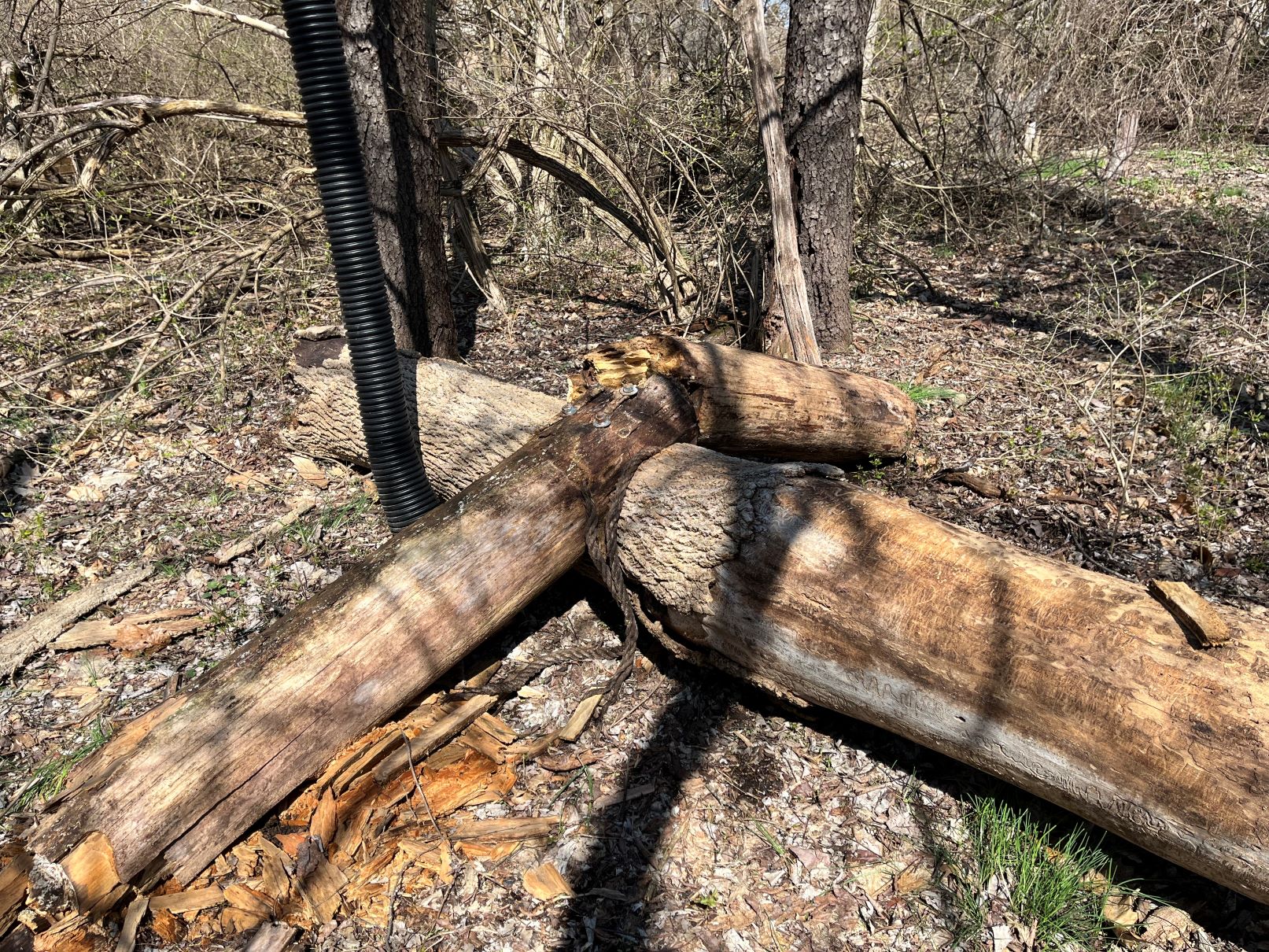
The chapel is also special to me because it was originally started as a fellow Eagle Scout’s project. My favorite feature of the chapel has always been the big cross at the front which was made from a dead tree stump.
But this spring the painful decision was made that the big cross had to come down. The old tree stump had become increasingly unstable due to age and insect damage. So for safety reasons our old rugged cross is no more. We are in the process of deciding what we will put in the old cross’ place. A committee is asking for suggestions for what should come next, but that cross was so perfect for that setting that I cannot yet imagine what could come close to being as meaningful.
The fallen cross seems a fitting metaphor for the grief and uncertainty of the day between Good Friday and Easter. I cannot really imagine the depth of the pain and fear those women and men who loved Jesus so dearly and witnessed his execution on that Friday when the sky turned black. I can’t feel what they felt because I know the rest of the story. We know that the cross is not the end. Thanks be to God
I had a Martin Luther moment this morning. No, I didn’t nail any theses to a church door. It happened like this. I had a busier than usual early morning for me, which means I was dressed and doing some slightly physical labor outside by 9 am. Mornings are hard for me anytime. My arthritic joints complain loudly when pressed into action too soon after I get up.
All of that is to say that my outside chores required more exertion than they used to, and I managed to work up a sweat. I hadn’t planned on showering this morning because I wanted to work out later in the day, but I had a PT appointment and wasn’t fit to go without a shower. As I finished the shower I remembered the story that Martin Luther always reminded himself that he was baptized whenever he bathed. At that moment I realized how fresh and renewed I felt. It was like the warm water had had not only washed away the sweat and relaxed tight muscles, it wrapped me in the grace-filled water of baptism.
This being Holy/Maundy Thursday I had read two devotions earlier this morning about Jesus washing his disciples’ feet, including those of Judas. The familiar story of Jesus overruling the objections of Peter who argued their roles should be reversed reminded me of Jesus’ own baptism where John makes a similar plea that Jesus should be the one doing the baptizing.
One of my favorite moments in the musical “Godspell” is the baptism scene. When John asks Jesus what he’s doing there Jesus simply replies, “I came to get washed up.” And on this Holy Thursday I marvel anew at the integrity and consistency of Jesus’ ministry. From baptism to foot washing he shows us the meaning and the power of humble servanthood. He arrived in Jerusalem that Sunday not in a Lincoln limo, but in a beat up Volkswagen bug. He came to show us in everything he did in the words of the great old hymn by Ernest W. Shurtleff (1887) that it is “not with swords loud clashing, or roll of stirring drums, but with deed of love and mercy the heavenly kingdom comes.” (From “Lead On, O God Eternal”)
Micah 6:8 is the verse I would pick from the whole Bible if I could only have one to describe the meaning of messianic living and what it means to take up a cross and follow Jesus. Holy Week provides the whole story of Christian discipleship in a nutshell as Jesus shows us what God requires of those who would fulfill the human potential our creator has instilled from birth/baptism in all of us. In those 6 days Jesus did justice, he lived mercifully, he did it all in humility, and like God the creator he rested on the Sabbath. And then comes rebirth and a new creation early on Sunday morning.
“When the day of Pentecost had come, they were all together in one place. And suddenly from heaven there came a sound like the rush of a violent wind”. (Acts 2:1-2 NRSV)
“Tornadoes killed at least 11 across Midwest, South. The sprawling storm system also brought wildfires to the southern plains and blizzard conditions to the upper Midwest.” WBNS TV headline, Columbus, OH, April 1, 2023
I attended the annual Schooler Institute on Preaching at the Methodist Theological in Ohio this past week. The lectures and preaching by Dr. Luke Powery from Duke University were excellent, but one word I heard for the first time has stuck with me. Dr. Powery’s theme for the two day conference was “Preaching and the Holy Spirit,” and one text he preached on was the familiar Pentecost story from Acts 2.
The “new” word for me is in the second verse of that chapter where it says “the rush of a violent wind.” I normally use the NRSV translation, and I didn’t remember that word “violent” being in that translation. I have always heard and read that verse describing “a mighty wind.” The word “violent” just strikes me as a strange way to describe the Holy Spirit of a gracious and loving God. (Sure enough when I went back to both copies of the NRSV Bible that I have, one that was copyrighted in 1993, both translate that word as “violent.” It was not till I went back to the King James Version of my youth that I found the translation that has been residing in my memory for decades. The KJV’s translation of that verse is “a rushing mighty wind.”) Maybe I’m in denial about the power of Holy Spirit, but I am still more comfortable with a mighty wind than a violent one.
When I think of a violent wind I don’t have to look beyond daily news stories about deadly tornados and cyclones that are a weekly occurrence this year, and that’s no April Fool. Here in central Ohio we are under a high wind advisory again today as I write this, exactly seven days after high winds here knocked out electricity for thousands of people. And we’re the lucky ones. Those were “mighty” winds in Ohio but not nearly as violent as other parts of the country and world have experienced.
The winds last week were the strongest I have ever personally experienced in my 76 years of life. They were officially recorded at 49 MPH at John Glenn International Airport in Columbus, Ohio. And now this weekend in addition to more deadly storms that have killed at least 22 people in seven states, a tornado touched down near my hometown of Wapakoneta in northwest Ohio. According to the National Weather Service we have had 130 tornados in the U.S. already this year which is a150% increase over last year. That’s what I would call some pretty violent winds.
In her book, “Saving Us: A Climate Scientist’s Case for Hope and Healing in a Divided World,” Katharine Hayhoe describes even more violent winds like Hurricane Maria that ravaged Puerto Rico in 2017. “It’s estimated to have caused several thousand deaths, while also destroying more than 80% of the territory’s utility poles and transmission lines. Storm damage caused the longest blackout in U.S. history—in some places, over eleven months without power. For many hospitals and senior citizen residences, this was a key contributor to the mounting death toll. “ (p. 178).
Sometimes mighty or even violent winds bring positive change as they did on the Day of Pentecost. Hayhoe reports that Puerto Rico is now building solar and battery capacity that will ultimately transition the island to 100% clean energy. Unfortunately in our time of extreme political partisanship such positive change only comes after terrible storm damage.
It was not always so. Ronald Reagan, yes that Ronald Reagan, stated in 1984, “Preservation of our environment is not a partisan challenge; it’s common sense.” Apparently many of our current Congress people didn’t get that memo.
In the face of all the floods, blizzards, tornados, and nor’easters we’ve already had in 2023 I am amazed that there has been almost no public outcry or discussion about the impact climate change is having as it increases the frequency and destructive force of these weather events. How can we explain this mass avoidance of the obvious and important threat to our way of life and perhaps the long term viability of life on Earth?
Perhaps the lack of attention to climate change is because there are plenty of other crises bombarding us for our attention, many of which are more immediate, like surviving and rebuilding after multiple natural disasters. Such existential crises make it very hard to think about solutions to a global problem that may not be fully realized in my lifetime. But it is coming for my children and grandchildren, and we can’t wait any longer to pay attention and do long-range planning.
One major reason for our willful avoidance of reality is what Alastair McIntosh describes as “denialism.” Hayhoe (p. 134) quotes McIntosh as defining it this way: “Denialism…keeps at bay what might be—fears, guilt and a sense of shame, not to mention all that lurks behind a need for CO2-belching markers of identity such as wait out in the car park.”
Hayhoe says those of us who are concerned about what’s causing the rash of deadly storms marching across our country every week may suffer from “eco-anxiety,” which the Oxford Dictionary defines as “extreme worry about current and future harm to the environment caused by human activity and climate change.” Ironically the dictionary adds that eco-anxiety is not considered to be a mental disorder since it is a “rational response to current climate science reporting.”
We have plenty of reason to be anxious and even fearful about the climate crisis that has been building to a crescendo ever since the Industrial Revolution began in the late 19th century. Fear is not a pleasant emotion, but it can be a positive force for good if we channel our eco-anxiety into creative ways to be better stewards of God’s creation. I’m sure the disciples were frightened by the mighty/violent win on the Day of Pentecost, but they didn’t let that fear stop them from sharing the Gospel with a crowd of people from a multitude of countries.
May these violent winds we are experiencing in 2023 transform us and propel us into action to speed up our responses to our climate crisis. As Kathryn Hayhoe puts it, “I believe it’s what we do with that fear that makes all the difference.”
This is a copy of my letter to Jim Jordan who is the Congressional Representative for the district in which I live:
Dear Mr. Jordan, Following the 129th mass shooting in the first 87 days of 2023 in Nashville I saw a quote in the media of your response to suggestions of some gun safety legislation. You reportedly said, “The second amendment is the second amendment.” I would argue that such an oversimplified response is totally wrong in multiple ways. Not only is it cruel and insensitive to the pain communities keep suffering over and over again as innocent children are brutally murdered, it is historically and legally just plain wrong.
First, the fact that we are talking about an amendment to the U.S. Constitution means this founding document of our democracy can and has been amended multiple times. The founders had the wisdom to realize changes to the Constitution would be necessary as our experiment in democracy progressed. And there is even precedent for an amendment, namely the 18th which prohibited the manufacture and sale of alcoholic beverages, being repealed by another, i.e. the 21st 13 years later. As important as the Constitution and its amendments, even the Bill of Rights, are, they are not sacrosanct.
How could they be when they were written and adopted by wealthy oligarchs who owned hundreds of other human beings? The second amendment, as you know, is one of the ten first amendments collectively known as the Bill of Rights. Those amendments were adopted and ratified by the states in 1791, just 3 years after the Constitution itself was ratified. One of the many things I did not learn in my high school history classes was the impact on American history of other events in the world, both near and far. For example, as the French Revolution was raging in Europe beginning in 1789 the enslaved people in the French colony of Saint-Dominique began a revolt for their freedom. That revolt ended in 1803 as the only successful uprising of enslaved people in world history, and also won independence from France and established the nation we still know as Haiti.
That unrest just 700 miles from Southern Florida was of great interest and concern to the plantation owners in the Southern states. Just as free and enslaved Blacks greatly outnumbered their white masters on Haiti, so too did they in the Southern parts of the U.S.
Fear of rebellion by the enslaved masses was a constant fear of plantation owners, including the shapers of the Constitution and four of our first five presidents: Washington, Jefferson, Madison, and Monroe, the latter being the primary author of the Bill of Rights.
So what gets omitted in our history text books is that a primary motivation for the inclusion of the second amendment in the Bill of Rights was a purely racist and capitalistic desire on the part of the enslavers to keep their “property” in enslavement.
I believe it was Maya Angelou who said, “When you know better, you do better.” It took from 1619 to 1865 for us to do better, i.e. abolishing the most flagrant form of slavery by the 13th amendment. While that horrible wrong took an embarrassing 246 years to change and while we still have a long way to go to end the systemic racism upon which slavery was founded, my point is that laws can change if there is the political and moral will to do so.
We are the only “developed” nation in the world whose children are being butchered in schools by weapons of war. We know how to fix this. Other countries have dwelt swiftly and successfully with mass shootings, but our uniquely American greed for power and wealth by our politicians and gun manufacturers are more highly valued than 9 year old children.
This should not be a partisan issue, but it has become one. And because it has become a political issue instead of a human issue, and because it is Republican members of Congress who are owned by the NRA who are unwilling to even consider common sense solutions to this problem it is time to state the sad truth. The only ways to stop these horrific killings is to vote Republicans out of office and replace them with people who care more about innocent lives than AR-15’s. I say that as one who grew up a proud Republican in the 1950’s, but Lincoln and Eisenhower would not recognize what Trumpism has done to their party. Just as amendments can change, so can political affiliation. A majority of Americans favor common sense gun safety legislation. We are tired of thoughts and prayers without action after every mass killing. Unless Republicans start listening to their constituents instead of the NRA they must and will go the way of the dinosaurs.
I am officially in the season of my life when my friends are reminding me of our shared mortality. No matter how hard we try to not be like our elders have been at our age, whenever we folks now in our 70’s get together in person or on zoom, sharing of health concerns tends to dominate or at least infect our conversations. I have for years had a dread of the time when one of my close friends dies, wondering when that may happen; and being grateful that I have been fortunate to reach 76 years without that experience. But now I know it is not a question of if that will occur, but when.
A year ago we lost a good friend who my wife had known for 40 plus years. I had only shared that friendship with her for 8 or 9 years. This year a good friend we’ve both known for 20 years is dying of lung cancer, and also two very good friends of mine whom I have known for over 50 years are facing possible life-threatening issues. Given all that the familiar warning of John Donne to not “ask for whom the bell tolls” takes on a whole new existential meaning.
I was researching another topic the other day and came across some curious biblical passages that address but add no clarity to the familiar quandary we all wrestle with—how long can I expect to live. On that topic Genesis 6:3 has God saying, “My spirit shall not abide in mortals forever, for they are flesh; their days shall be one hundred twenty years.” That could be both good news and bad. But only a chapter later we are told “Noah was six hundred years old when the flood of waters came on the earth.” (Genesis 7:6) And to further muddy the waters (no pun intended) Psalm 90:10 says, “The years of our life are seventy, or even by reason of strength eighty; yet their span is but toil and trouble; they are soon gone, and we fly away.”
If we want certainty about how long we can expect to live those verses certainly don’t help. They were written by different authors in very different contexts; but here’s what they are saying to me. No one really knows how long they will walk on this earth. We can let that uncertainty drive us crazy, or we can make peace with it and live in the only time we really ever have – Today. Some days it is easier to do that than others of course, but finding that peace that passes all human understanding always depends on how well we can surrender our doubts and fears to the very source of our life.
Surrender is hard for us competitive type humans. It sounds like defeat or loss, and most of us really hate losing. But this kind of surrender is just the opposite. It is victory at the deepest level to find relief from things we cannot conquer on our own but need to offer up to a higher power. Prayer can take a multitude of forms, but it is the best way we have to connect with that higher power and simply trust in the goodness and mercy only God can give.
As I was writing this, the words to an old hymn I have not sung for many years, but the lyrics to “What a Friend We Have in Jesus” by Joseph Scriven are still in my memory bank, and they really sum up this whole matter and many other mysteries of life very well. Those lyrics in part say,
“O what peace we often forfeit, O what needless pain we bear,
All because we do not carry Everything to God in prayer!”
When I was in Little League a hundred years ago, like every kid, I fancied myself a star shortstop, the most glamorous position on the diamond other than the pitcher. A couple of things doomed that dream. In addition to my diminutive size no one ever suggested I could improve my athletic chances by pumping some iron. So I was the perfect poster boy for a 98-pound weakling. My coaches very quickly determined I did not have the arm strength to play shortstop; so they moved me to second base where the throw to first base is much shorter.
I was reminded of that experience this week and also learned what a “wild goose chase” is all about. I came home from running errands one afternoon to find two Canadian geese floating on our quarter-acre pond as if they owned it. I like birds, just not messy, nasty ones; so as I have done in the past I set about inviting said geese to move on to other water. There are several other ponds in our neighborhood; so this seemed like a simple request. All they had to do was fly across the road and they would have several other lovely ponds to choose from.
When the geese ignored my suggestion that they move on I escalated my efforts, clapping my hands and raising my voice as I walked toward the pond. They literally turned their backs on me and calmly paddled toward the other side of the pond. To understand distances involved you need to know that it is about 40 yards or 120 feet across our pond. By comparison the distance from deep short stop to first base on a Little League field is maybe 80 feet. I point that out because last year when unwanted geese on our pond ignored my most persuasive rhetoric I found that throwing a small rock in their general direction was enough to get them to fly away. I didn’t try to hit them, just scare them, and it worked. That was last year. This week when I tried that tactic the first stone I threw didn’t travel 40 feet before falling weakly into the drink.
So I began circling the pond trying to scare the birds away and/or to get closer so I could frighten them with a rock splashing in their vicinity. As I circled the pond the geese just kept calmly paddling around the pond away from me, and every effort I made at throwing a rock was feebler than the last. After completely circumnavigating the pond, I was no closer to the dirty birds that when I started, and I swear I heard them laughing at me.
And that got me wondering about where else that shows up in my life? What other frustrating pursuits do I waste my time on? How about you? Are there wild goose chases you need to give up?
Paul tells us that suffering produces endurance, which produces character, which produces hope. Even though this winter has been mild I figure having lived through 77 Ohio winters; I should be one of the most hopeful characters in captivity.
Suffering is not my favorite thing about being a Christian. In fact, if we were to do a top 10 list of my favorite things about being a Christian, suffering wouldn’t even be on it. I really identify with the Disciple Peter who argues with Jesus in Mark 8 when Peter tries to talk Jesus out of his need to suffer and die, remember what Jesus says to him – “Get behind me Satan, you re on the side of men not of God?” Pretty harsh reply from Jesus, don’t you think. But if we look more carefully at that story Jesus goes on to say, “take up your cross and follow me…” you see, following requires that we line up behind the leader. Remember those days in elementary school when you lined up to go everywhere, and this leader that we profess to follow, whose name we claim as Christians, makes it clear over and over again that cross bearing is part of what we have signed on for at our baptism.
For Christians, suffering goes with the territory, unless we want to give up the reward for genuine suffering, which is eternal life here and forever. In Romans 8, Paul says, “We suffer with Christ so that we may be glorified with him.” But we still wish it wasn’t so, don’t we? When I first heard a story about a Good Friday cross walk several years ago when the faithful from several churches gathered in Dublin, Ohio for their walk and realized they had no cross with which to walk, I said, “That’ll preach!” Wouldn’t we love to have Easter without the suffering and pain of Good Friday and the Garden of Gethsemane? –the betrayal and denial that break Jesus’ heart long before the executioners break his body?
I would. I am not a fan of the” no pain no gain” school of exercise or theology. If there is an easier way to get in shape than sweating and having sore muscles, I’m all over it. And if someone can find an easy path to salvation, I’ll be the tour guide. But, oops, there’s that nasty verse in the Sermon on the Mount, Mt. 7:13-14 that says the wide easy freeway leads to destruction, and that’s the one without the cross, the one most people choose, because it looks easier and lots more fun in the short run. But when it comes to matters of faith, don’t we want to focus on goals and consequences for eternity, not just for today?
There are different kinds of suffering, and some are easier to explain or to deal with than others. First, and easiest in some ways, is the kind of suffering we bring upon ourselves. Kanye West and Will Smith come to mind as two of this year’s nominees in that category. Or anyone who was injured trying to take a selfie in a dangerous place? You can think of other nominees, less famous ones, perhaps, and if we’re honest we could all be on that list at one time or another.
The difference for most of us is that we aren’t celebrities. Our screw ups usually don’t show up on channel 10 news or in big bold tabloid headlines for the world to read in the checkout line at Kroger’s. But that doesn’t mean they are any less painful or hard to live with. Mistakes have consequences, which mean they usually hurt us and/or other people, and hurting is a form of suffering. We all make bad choices, it goes with our free will that none of us want to give up. We make bad choices that impact our health; we drive when we are distracted by electronic gadgets or when our judgment isn’t 100%; we say things in anger that we regret; we break promises to people we love. We give into worldly pressure to succeed or cut corners, knowing we’re violating our own values, and we may get away with it for awhile, or think we have; but sooner or later, our chickens come home to roost and we suffer.
That kind of suffering is very painful and hard to deal with, in part because we know there’s no one else to blame but ourselves, but at least self-inflicted suffering makes some sense. We can understand where it comes from and why.
The second type of suffering makes less sense to me. It’s been 12 years now, but I still remember the heart-wrenching and horrifying images of the Tsunami in Japan in 2011. Innocent, helpless people, thousands of them, minding their own business one minute who were suddenly swept up in what looked like science fiction movie about the end of the world the next. Or name any mass shooting or the inhumane brutality of Putin’s now year old war on Ukraine. Suffering type number 2 is the kind caused by natural disasters or criminal attacks or lung cancer in someone who has never smoked a cigarette; the kind for which there is no justification or satisfying explanation. Innocent children who are physically or emotionally or sexually abused. Faithful spouses who are cheated on, taken advantage of and left with nothing to sustain life. You get the picture.
This is a good place to clarify what suffering isn’t. Shortly after the 2011 earthquake and tsunami, the governor of Tokyo made a public pronouncement that he believed this disaster was divine retribution on the people of Japan for their greed. This gentleman is a follower of the Shinto religion, and I have no knowledge whatsoever of what Shinto theology is or believes. I do know there are those tempted in most religions to resort to blaming God for things when we can’t figure any other way to justify or explain why bad things happen. Christianity is not exempt from such bad theology, and I remember there were Christian preachers who claimed that hurricane Katrina devastated the gulf coast in 2005 because of the sin and wickedness of the Big Easy.
Please understand, I’m not saying actions don’t have consequences or that sin doesn’t cause suffering – those things are built into the natural order of things. But that does not mean that the loving God I know and worship would kick people when they are down by saying “Gotcha” or “Take that, sinner” over the broken and shattered ruins of a devastated life or city or nation. When we need God’s comfort and strength and presence the very most, in times of tragedy and loss and despair, would God choose that time to teach us a lesson? NO, that is the time that Emmanuel, God with us, carries us and comforts us. When we suffer God is close enough to us to taste the salt of our tears.
Now, I know you can find plenty of places in the Bible where we are told that God punishes sinners with plagues and boils and hell fire and damnation, and we need to deal with that problem head on. Even in our text for today Paul says we need to be saved from the wrath of God. The Bible was written over centuries by lots of different authors who were trying to answer the hardest questions and mysteries of life. Those who experienced God in their suffering as punitive and judgmental wrote about that experience, and almost all of them did so without the benefit of knowing Jesus Christ, who is the best revelation possible for the loving, forgiving, grace-full God we have come to know and love through Jesus.
We need to remind ourselves that the Jews who wrote their Bible, which we call the Old Testament, also knew the loving, merciful side of God, too. That compassionate part of God’s nature had just not come into clear focus for them as it did in the incarnation of God in Jesus’ human form. We sometimes forget that most of our great images of God, like the good shepherd of Psalm 23, or God as a mother hen gathering her chicks about her all come from the Hebrew Scriptures. The essence of Jesus’ teaching, for example the Great Commandments to love God with all one’s heart, soul, strength, and mind, and to love your neighbor as yourself are straight from the book of Deuteronomy.
Paul tells us that suffering produces endurance, character and hope. We can see how these first two kinds of suffering can build endurance and maybe character, but what about hope? We need a third kind of suffering to build Hope, and that is what followers of Jesus do when we voluntarily take on suffering as an act of sacrificial compassion. The reason Christians embrace and even boast about suffering, as Paul describes it, is that com-passion is essential to the Christian faith, and the word “compassion” comes from two Greek words that mean to suffer with. Compassion is the kind of love Jesus came to teach and live. Compassion is the love we feel for neighbors and enemies we don’t even know, simply because we share a common human condition. Compassion is what we feel for the people of Ukraine because we identify and empathize with them and share their suffering as fellow members of the human family. God doesn’t have grandchildren – just children – so our fellow human beings are not cousins once or twice removed, but are all our siblings – brothers and sisters together with Christ.
Compassion is a key to God’s very nature. Why else would God allow Jesus to suffer and die for us while we are yet sinners? When John tells us that God so loved the world that he gave us Jesus – that’s compassion and empathy to the max. God becomes one of us in human form to share our existence, including our suffering.
The cross of Jesus is often misunderstood as a necessary sacrifice or punishment for the sins of the world, but when we experience the cross of Christ as an act of compassion and sacrificial love it is much easier to embrace and to imitate in our own lives. The suffering of the cross for Jesus is an example writ large about how a person of faith handles suffering. Jesus doesn’t repay evil for evil; he doesn’t lash out in violent anger when he is suffering. He continues to live life in harmony with the will of God, bearing the ultimate suffering in love, compassion and forgiveness – staying true to the way of love which is the essence of life and of God. How can we follow Christ’s example and take on the suffering of life with character and hope? Paul says, “Hope does not disappoint us [even in the worst of times] because God’s love has been poured into our hearts through the Holy Spirit that has been given to us.” We can’t do it, but God living in us can.
The cross is both a symbol of suffering and hope, because if Jesus’ life ended on Good Friday, suffering would be the final fate of human kind. Death would define our existence. But hold the phone; we know the rest of this story. “Suffering produces endurance and character and hope, and hope does not disappoint.” For those who don’t give up and leave the ball game when the score looks hopeless, there is good news. We’ll experience that in its fullness in a few weeks on Easter morning, but for those of us fortunate to be post-resurrection people we already know that suffering and death are not the final chapter in our story. Thanks to God’s ultimate, victorious will, we can endure suffering and even embrace it because we know it builds our character and makes us people of hope with Easter in our eyes.
Holy one, I want to practice what I preach/write about as we begin this Holy season of Lent. [See my previous post from February 21 for reference to Galatians 5 and fruits of the Spirit.] The two words from Galatians that are speaking to me this morning are “self-control,” as one of the good fruits of the Spirit and “anger” from the list of opposites. I know righteous anger can be helpful. Jesus and the prophets frequently address their anger at injustice and hypocrisy. I don’t have a problem with that kind of anger. Mine is petty, self-centered anger over little, insignificant things that don’t go the way I think they should in my daily life.
That kind of useless anger poisons my soul. It drowns out words of grace and mercy toward others and myself. It blocks love of myself and others and even you when I blame you for the inconveniences I encounter which are a normal part of the imperfect world we live in. I know people that only see me in my pastor role or even in the good face I put on in public may be surprised that I struggle with self-control and anger. Why is it that with the one I love the most I can be the most unloving? Is it because I am tired of pretending to be the good Steve in public that I let the dark side come out as soon as I get home? Is it because I feel safe in a place of unconditional love that I let me anger and frustration get the best of my self-control? Is “self-control” itself an oxymoron or a poor choice of words to be in the good fruits list? I wonder what the Greek word that gets translated as “self-control” is, or is that an intellectual rabbit hole to avoid really looking at myself? Might it be that I really need to surrender control instead of trying like a two year old to “do it self?” As usual I have more questions than answers, but isn’t that where faith comes in? Walk with me on this journey to resurrection, Lord, as you always have. Amen
My brain was working overtime on Presidents’ Day Monday. I just finished Jon Meacham’s excellent biography of Abraham Lincoln, “And There Was Light.” Ash Wednesday is only two days away, and a Monday book club I am in is reading “Saving Us,” an excellent book on climate change by Katharine Hayhoe. I think the latter probably explains the song I had running in my head most of Monday morning. I have always found a lot of meaning in song lyrics, including several from Rodgers and Hammerstein musicals that our choral music department produced many decades ago when I was in high school. Monday’s song was the title song from “Oklahoma,” or rather one line from that song: “We know we belong to the land, and the land we belong to is grand. You’re doing fine Oklahoma, Oklahoma OK.”
Those words got me wondering what a difference it would make if we humans made a simple paradigm shift to believe we belong to the land instead of vice versa? The whole notion of individuals or corporations owning pieces of the earth was a foreign concept to Native Americans when it was introduced by the European invaders, and given the way we have raped and pillaged the earth and started endless wars over “ownership” of the land it seems the “uncivilized” peoples may have had the better idea.
The Lincoln story of course deals in great detail about one of those horrible wars fought over expansion of and control over the vast territory that makes up over a third of our current United States geography. The final question that pushed the slave owners to resort to violence was whether the western territories would be settled as slave or free? The best minds of the 19th century, men like Henry Clay and Lincoln could not find a peaceful resolution to that moral and existential question of human equality, and the racism upon which the U.S. Constitution was built still plagues us today. I am reminded of Exodus 20:5 which says, “I the Lord your God am a jealous God, visiting the iniquity of the fathers on the children to the third and the fourth generation of those who hate me.” It has been far longer than three or four generations since Lincoln issued the emancipation proclamation. The institution of slavery was made illegal, but the dreadful racism at its core is still visiting iniquity on us. How long will it be until that evil has been exorcised from American hearts?
Much has been written about the spiritual revival going on the last two weeks at Asbury University in Kentucky. Whether that event is a true revival or just a very long worship service remains to be seen. Jesus said, “You will know them by their fruits” in Matthew 7:16, and my litmus test for the fruits a true revival will bear is succinctly stated in Micah 6:8 where we read,
“He has told you, O mortal, what is good, and what does the Lord require of you but to do justice and to love kindness and to walk humbly with your God?”
Ash Wednesday is but a few hours away as I write these words now, and that day marks the beginning for Christians of a 40 day preparation of our hearts and minds for the celebration of Easter. Forty days holds great symbolism for those of us in the Judeo-Christian tradition. Great times of testing and reflecting on the meaning of our faith are often identified in Hebrew and Christian Scripture by the number forty. In the flood story the rain fell for 40 days. Moses was on Mt. Sinai for 40 days when he received the 10 Commandments. The Israelites wandered in the wilderness 40 years on their way to the Promised Land. Jesus was tempted by Satan for 40 days in the wilderness immediately after his baptism. And it was forty days after Easter when the resurrected Christ ascended to Heaven.
In our troubled times we dare not cheapen the forty days of Lent by just “giving up” something we should never have had in the first place. To make Lent 2023 a significant time of spiritual awakening and renewal of a right spirit within us we need to look deeply into our souls and do an honest inventory of what’s in our spiritual pantry. Are the fruits of the spirit fresh in my life or are they rotting and moldy from lack of use. Galatians says, “By contrast, the fruit of the Spirit is love, joy, peace, patience, kindness, generosity, faithfulness, gentleness, and self-control. (5:22-23) Those are all wonderful qualities the world desperately needs, but what do they really mean for our lives if they are to be more than pious platitudes? And what about those two words ‘by contrast” at the beginning of that list? Sometimes we can learn what certain words mean by exploring their antonyms. So it may be helpful to look at what Galatians has to say about other human qualities that are the opposites of the fruits of the spirit?
The verses preceding 22 and 23 say, “Now the works of the flesh are obvious: sexual immorality, impurity, debauchery, idolatry, sorcery, enmities, strife, jealousy, anger, quarrels, dissensions, factions, envy, drunkenness, carousing, and things like these. I am warning you, as I warned you before: those who do such things will not inherit the kingdom of God. “ (Verses19-21).
What if this Lent we made a commitment to pick one of the fruits of the spirit to focus on for our spiritual growth? Pick just one so as not to be overwhelmed and look for examples in others who embody love, joy, peace, patience, or one of the other gifts. Pick just one. Pray about it and for it. These are gifts, something we receive from God, not something we can just make up our minds to do. And when we fail to live generously, for example, as we most certainly will, don’t give up, but ask for grace and forgiveness and try again.
One of the best ways to learn a new behavior is to model our own actions after someone we admire. When I was thinking about these intertwined themes of Presidents’ Day and Lent I was reminded of another President who has been in the news this week. Jimmy Carter has gone into hospice care and is nearing the end of a long and remarkable life. President Carter was not a very successful president by worldly standards. He was denied a second term by an economic downturn and the Iranian hostage crisis. But oh what a mark he has made on the world in the 43 years since he left office. He and Rosalynn, his wife and partner of 75 years have lived simple lives of service to others, building homes for the poor with their own hands, building peace by applying their Christian values to international crises, being honored with a Nobel Peace Prize, and all the while continuing to live in the same humble home and teaching the Bible in their church and with their lives.
We would all do well to pick a fruit of the spirit exemplified in the life of the Carters and spend this Lent nurturing and watering that fruit so it can multiply and feed the souls of those around us.




 Peacefully Harsh