2nd Sunday of Advent 2023

This image has an empty alt attribute; its file name is advent-2.jpg

Ever since the angels proclaimed their message of “peace on earth” to the shepherds of Bethlehem our weary world has lived between that promise of peace and humankind’s warring madness.  It seems we have waited so very long for peace. Our patience wears thin and our hope is challenged, but we are reminded by Scripture that “our time is not God’s time.”  Our perspective is limited and brief, but God’s is infinite and eternal. 

Being patient while we wait is so hard for us finite humans.  2000 years since Jesus’ birth we are still longing for fulfillment of God’s promise, even as we prepare our hearts again for the miracle of Christmas.   We give thanks for God’s grace and patience with all of His fallible children.  We humans still live caught between peace on one hand and fear on the other because of our own love of power and our human weaknesses. 

But even if it seems foolish by the world’s standards, here and now today we still dare to light this candle of peace, the second candle of Advent.  This candle is far more than wax and a wick; it is a witness to the world that God’s promise of a peace that surpasses all understanding is still trustworthy and true. 

[Light candle]

Please pray with me as I share this prayer from Kate Bowler and Jessica Ritchie, from their book, “The Lives We Actually Have:”

Come, Lord, that we might see you, move with you, keep pace with you.

Blessed are we who ask that this Advent          

we might dwell together quietly in our homes.

Come, Lord, that we might be for others the peace they cannot find.

Blessed are we who look to you and say, God, truly, we are troubled and afraid.

Come govern our hearts and calm our fears.

Oh Prince of Peace, still our restless selves, calm our anxious hearts,

quiet our busy minds.

Hear our prayers O Holy One, which we offer in the name of Jesus Christ, the Prince of Peace.  Amen

Northwest UMC, Columbus, OH, December 10, 2023

An Eye for An Eye?

Ever since October 7 I have been pondering the irony of the Israeli response to the horrific massacre of 1200 Israelis by Hamas.  One of the most familiar tenets of the Hebrew law found in Leviticus says, “Anyone who maims another shall suffer the same injury in return: fracture for fracture, eye for eye, tooth for tooth; the injury inflicted is the injury to be suffered.” (24:19-20). I learned two things about that Scripture in seminary: 1) It is very similar to another ancient law, The Code of Hammurabi, a Babylonian King in the 1700’s BCE, and 2) both the Code of Hammurabi and the Hebrew law were meant not to justify revenge but to limit the amount of revenge one could seek for an offense to an equitable amount.  So, for example, if someone poked out one of my eyes I could not in return poke out both of his or hers. 

Jesus came along 3000 years after Hammurabi and 1400 years after Moses and raised the bar to a whole new level in the Sermon on the Mount where he says, “You have heard that it was said, ‘An eye for an eye and a tooth for a tooth.’ But I say to you: Do not resist an evildoer. But if anyone strikes you on the right cheek, turn the other also,and if anyone wants to sue you and take your shirt, give your coat as well,and if anyone forces you to go one mile, go also the second mile.Give to the one who asks of you, and do not refuse anyone who wants to borrow from you.“You have heard that it was said, ‘You shall love your neighbor and hate your enemy.’  But I say to you: Love your enemies and pray for those who persecute you,” (Matthew 5:38-43).

Now, I’m not expecting the Israelis to live up to Jesus’ ethics.  I can’t, and I’m not sure anyone but Jesus could ever do that.  But it seems like not killing your enemy’s innocent women and children might be a start.  And it does seem fair to hold the Israelis to their own Scriptural standards.  At last count the Israelis have killed 16000 Palestinians in Gaza.   That’s more than 10 for every Israeli killed on 10/7.  That’s a lot more than “an eye for an eye.”

I understand the horror of that dark day.  No, I don’t.  Thank God, I have never experienced anything like it.  I was even far removed from any personal suffering on 9/11.  So, I know I have no right to judge.  I don’t know what I would do in the Israeli shoes.  Nor do I have any idea how I would survive the God awful inhumane conditions the people of Gaza have been living under for the last 60 days.  I just know the insane suffering I see on my TV screen has got to stop.  Not just because it is morally unjustifiable but mostly because it is just plain counterproductive.

War and killing have never solved anything.  If the Israelis could actually eliminate Hamas and terrorism by use of force there might be an argument for their military campaign.  But it won’t work.  The anger being fanned in the Muslim world by the war in Gaza will produce far more terrorists can ever kill.  If history has taught us anything it is that revenge only begets more violence in return.  That’s the point of Jesus’ teaching above about turning the other cheek.  To resist the natural human urge to strike back in anger, as impossible as that seems, is the only way the cycle of violence can ever be stopped in its tracks. 

As progressive as it was in the days of Hammurabi, as Gandhi once pointed out, “An eye for an eye and a tooth for a tooth just creates a world of blind, toothless people.”

I know that too criticize Israel opens me to charges of antisemitism, but I assure you I am not anti-Semitic.  I am a Christian nurtured in the Judeo-Christian tradition.  Jesus was a Jew.  I am constantly challenged and inspired by the Hebrew prophets.  I grieve for the hostages still in captivity, for the suffering of the Jewish people throughout history and on 10/7, but the killing needs to stop; the suffering of the people of Gaza must stop. 

December 5, 2023

Advent I 2023: Hope

Today is the first Sunday in the season of Advent.  It is a time of preparing our hearts to receive once more God’s promise of healing for our broken world.  Advent is a season of waiting and hoping for what is already but not yet.  It is a time of living in between – between promise and fulfillment, between hope for and receiving.  

This Advent it is harder than usual to be people of hope. The skies over the Holy Land are full of rockets and bombs instead of an angel chorus. We live between Christmas carols on the airways and horrific images of war on our news feeds.

But here, even in this time between hope and despair, we gather to reaffirm our faith in the eternal light that cannot be extinguished by any amount of human sin and suffering. As people of faith have done for hundreds of years we claim the gift of hope once more by lighting the first candle of Advent.

[Light Candle]

Please pray with me as I share this Advent prayer from Kate Bowler and Jessica Ritchie, from their book, “The Lives We Actually Have:”

“God, these are darkening days, with little hope in sight.

Help us in our fear and exhaustion. Anchor us in hope.  Bless us who cry out: ‘Oh God, why does the bad always seem to win?

When will good prevail?

We know you are good, but we see so little goodness.’

God, show us your heart, how you seek out the broken.

Lift us on your shoulders and carry us home—no matter how strong we think we are.

God, seek us out, and find us, we your tired people, and lead us out to where hope lies. where your kingdom will come and your will be done, on earth as it is in heaven.

Fill us with your courage. Calm us with your love. Fortify us with your hope.”

We pray in the name of the One we Hope for who already walks with us every day. Amen

Northwest UMC, Columbus, Ohio, December 3, 2023

Help from Our Friends

“Then some people came, bringing to him a paralyzed man, carried by four of them. And when they could not bring him to Jesus because of the crowd, they removed the roof above him, and after having dug through it, they let down the mat on which the paralytic lay.” (Mark 2:3-4)

I had a very humbling experience last week that reminded me of the story from Mark’s Gospel about the paralyzed man brought to Jesus in a most unusual way. All three other Gospels contain a similar story where someone is carried to Jesus for healing, but only Mark has this most dramatic detail about the man’s friends being so committed and creative that they lowered him down to Jesus through a hole they dug in the roof.

Wouldn’t you love to hear the insurance adjuster’s response when the homeowner explains the hole in the roof with this story? My experience last week was far less dramatic but still very emotional for me.

The back story, no pun intended, is that because of chronic back pain and peripheral neuropathy I sometimes have a difficult time walking any distance. This is especially true after I’ve been sitting in a confined space, like an airplane seat, for any extended period of time. Last Wednesday my wife and I flew from Columbus, Ohio to Houston, Texas to visit family for the Thanksgiving holiday. The flight was delayed for 30-40 minutes while we sat on the tarmac in Columbus waiting for the pilots to arrive on another delayed flight from Houston. That made the total time on the plane around 3 hours.

Upon arriving at the Bush Intercontinental Airport in Houston we had a long walk (and a train ride) from Terminal E to baggage claim in Terminal C, and I was struggling to get there pulling a carry on and wearing a backpack. My dear wife offered to help with my luggage, but she already had plenty of her own; and I stubbornly kept pushing on.

By the time we got to Terminal C I was really tired and unsure how much further we had to go. We stopped to ask for directions from an airport employee who just happened to have an empty wheelchair, and he graciously offered me a ride. He was a life saver, and I was very grateful for his help. He not only pushed me to baggage claim, he took our claim tickets and got our luggage for us and then took us another good distance to where we could catch a shuttle to the car rental center. He even loaded our suitcases on the shuttle bus for us.

But here’s my problem. While I was very grateful for the assistance we received, I still felt helpless and frustrated that I needed that kind of help. I have not come close to mastering St. Paul’s advice in Philippians 4 to ”be content in whatever state I’m in.” I am reminded every time I look in the mirror that I am 77 years old, and if I forget, my aches and pains remind me of that fact; but I still try to deny it.

So I wonder how the paralytic man in the Gospel stories felt about his situation. We aren’t told why or how long he has been paralyzed. We don’t know if he asked these friends to take him to Jesus or if it was their idea. We don’t know how he felt about being carried up on the roof. That had to be little scary for him!

The truth is the story really isn’t about the paralytic, just as my wheelchair ride wasn’t really about me. The Gospel story is primarily about Jesus, and my story if I step back from my own pity party is really about the kind man who helped us. Yes, he was doing a job he is paid to do, but he did it with such kindness and grace that it was obviously more than just a job.

And Mark’s point in sharing this story in just the second chapter of his Gospel is not primarily about the paralytic but about the healing power of God and who Jesus is. We need to read the first chapter of Mark to realize how central that fact is. Mark wastes no time getting to the radical ministry of Jesus. In the very first chapter he includes four specific healing stories, including Simon’s mother-in-law, casting out many demons, a man with an unclean spirit, and a leper. He goes “throughout all Galilee,” and even though he tells them all not to tell about their healing by the time he returns to Capernaum even though there was no social media to promote his good works Mark tells us “the whole city” is crowding around to get to Jesus. He’s a bigger celeb than Taylor Swift.

But here’s the thing about the story in Mark 2; it’s not just another healing story. For the first time Mark tells us Jesus dares to forgive the paralytic’s sins, and that of course ticks off the Scribes who are nearby and take offense that Jesus dares to claim such divine authority. I love Jesus’ response to the Scribes. He basically says, “OK, to show you my power, how about I just say to the man ‘take up your bed and go home?’” Which of course the miraculously healed man does, and the crowd is amazed because “we have never seen anything like this.”

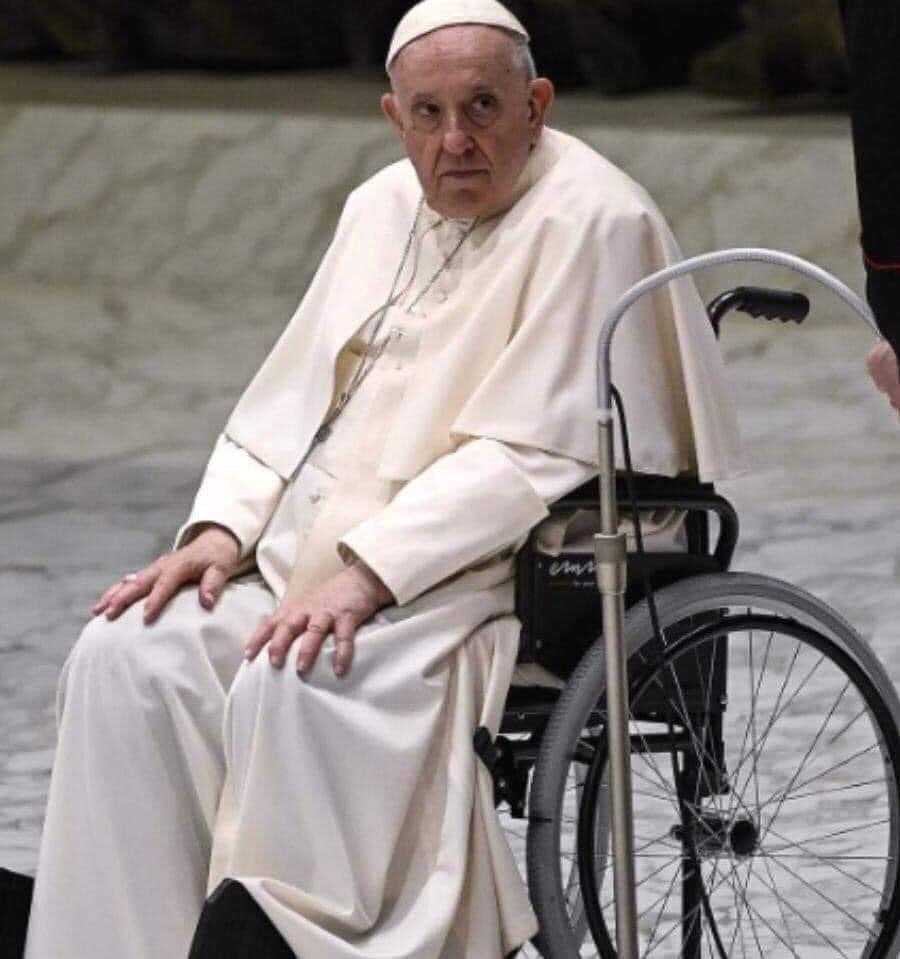
As I was thinking about all of this I came across this picture of Pope Francis, and it hit me again. My story like the paralytic’s story are not about the helpees but the Helper. If a great man like Pope Francis can accept the help of others who am I to think I am somehow better than that. The truth is we are all dependent on the help of others. It may be emotional support or sometimes physically taking us to the spiritual or physical help we need. It may be realizing we are dependent on the farmers, truckers, and grocers who get food on the shelf for us to purchase.

The secret to it all is being humble enough to recognize and ask for whatever help we happen to need at any given point in life. We all come into this life totally dependent on others to nurture, protect, and care for our needs for several years, and the cycle of life means that most of us will end up pretty much in the same need for caregivers at the end of this life. Our choice is how humbly and graciously we accept that care.

Where’s the Justice?

Election Day, praying for my tribe to win as much as possible even as I fear the dangerous person just elected Speaker of the House and the Trump circus in a New York court room. Trump has succeeded in taking the media spotlight off the mayhem in Gaza, but the slaughter continues there and elsewhere. A mass shooting in Cincinnati recently barely made the news.

We are having new skylights installed today while millions of people have no roof over their head at all. Where is the justice?

My privilege feels like a millstone tied around my neck, even while I resent working for hours on end the last two days to maintain our wonderful home.

I get wonderful medical care for my puny aches and pains while hospitals are bombed in Gaza. Where’s the justice?

I simply turn the tap and open the fridge whenever I thirst or hunger while millions of climate refugees and war victims around the world are starving and dying. Where’s the justice?

By accident of birth I am a privileged white male in a relatively safe and prosperous nation. My ease and comfort are as undeserved as the suffering of innocent Israelis and Palestinians and Ukrainians is unjustified. Where’s the justice?

If I thank God for providing so bountifully for me and my tribe anyone can see the irony that all these others of God’s children who pray to the same God still suffer so horribly. I am not some worthy saint being rewarded for my good behavior like a school boy getting gold stars for what we used to call “deportment.” If I am graded on keeping the 10 commandments or living by the Boy Scout Law I learned as a youth you better believe I hope God grades on the curve. Where’s the justice?

As we Christians paused ever so briefly this week to observe All Saints Day our grief and memories of those who have passed beyond this mortal coil are tied to the deaths of all those unknown to us but known to God souls lost in recent days to the madness of war. Nadia Bolz-Weber said it so well in her sermon for Sunday, “You’re going to die:”

“The untimely and unnecessary deaths of 10,000 children of God, many of whom are actual children, in just that one tiny area of our planet in one month’s time ripples out into an ocean of grief for the 100,000s of thousands who know their names…their babies, and brothers and wives and friends.

This is their day too.

So as we remember our own dead, may we feel connected to the sorrow of those who are also grieving today. And say as our lord did, Blessed are they who mourn. Blessed are they who have loved enough to know what loss feels like.”

I had never thought about grief as a blessing even though I have read those words from the Beatitudes dozens of times. “Blessed are those who mourn.” My thoughts always jump to the second half of that verse “for they shall be comforted.” Yes, we yearn for our own comfort and those of others. But there is no comfort without grief, just as there is no resurrection without death. So in one of those theological twists of fate there is gratitude even for pain. If we could not feel the pain of grief, even for people 10,000 miles away, we also could not feel love and appreciation for our privilege.

I do not deserve my comfortable life any more than the trapped citizens of Gaza deserve the horrors of modern warfare, any more than the 1400 Israelis deserved to die on October 7, or the 6,000,000 Jewish victims of the Holocaust, or the 3000 Americans deserved to die on 9/11. All of that reminds me that life itself is a privilege to be cherished and lived to its fullest no matter where we have landed by accident of birth on this fragile planet.

May our gratitude for what is take the wings of mercy to act as those who do justice here and now, who love mercy wherever we are planted, and through it all walk humbly and gratefully with the One who gives it all and who alone can fathom the mystery of life and death in our broken and unjust world.

A Blues Prayer

Hi God, it’s me again.  I am so bummed.  The whole mess in D.C. and Gaza/Israel is just sapping so much energy from me.   I’m a pastor and writer, but I’m not sure even what can be said.  The forces of violence and vengeance are so much in control of the world as usual that innocent suffering doesn’t matter. I have to tell you, Lord, the ways of peace seem so puny and weak against drones and bombs dropped on refugee camps.  How can those in power be so unmoved by the suffering and death of thousands?  Are they so insulated and hardened by years of power madness that the pain doesn’t reach their hearts?  It is so terribly sad and discouraging since it has been this way from the beginning of time.  It seems so irresponsible on my part to try and live life as usual – but then we have two good friends in nursing homes and their suffering and that of their family and friends on a different level, but still quite real.  Combine that with the cold dreary weather and my own health concerns and life sucks big time.  Woe is me.  I’m turned in on myself and too much focused on the half empty glass.  I know that, but what to do about it?  I just started my 78th trip around the sun this week and should be smarter by now.  Where is the wisdom that is supposed to come with age when I need it? O God, please give me patience and courage for the living of these days.  Amen

Eucharistic Blackmail

“Then he took a loaf of bread, and when he had given thanks, he broke it and gave it to them, saying, “This is my body, which is given for you. Do this in remembrance of me.” And he did the same with the cup after supper, saying, “This cup that is poured out for you is the new covenant in my blood. But see, the one who betrays me is with me, and his hand is on the table.”  (Luke 22:19-21)

I heard something from a friend this week that has left me adrift in a sea of incredulity.  Given the bitter divisions in our nation and my denomination I should not have been shocked, but I was.  This friend is a former member of a United Methodist church I used to serve.  She is one of the casualties of the great United Methodist schism of 2022-23.  She told me that a relative who still attends the now Global Methodist Church reported the following from their worship service last Sunday:  prior to communion the pastor told the congregation that anyone planning to vote for Issue One in the upcoming Ohio general election should probably not take communion.

Issue One is a constitutional amendment that will protect reproductive rights and access to abortion.  This is a very controversial and emotionally charged issue, and while I respect the opinion of those who oppose Issue One I do not think access to the Sacrament of Holy Communion should be used to persuade or intimidate anyone to vote in any particular way. 

I don’t know what the position of the Global Methodist denomination is on who may or may not receive this sacrament, but in the United Methodist Church we practice an open table.  As a pastor I would never presume to judge who is worthy or unworthy to come to the Lord’s table because it is the Lord’s table, not mine or my church’s.  The exemplar for that inclusive table is the Upper Room itself on the night before Jesus is crucified.  The Gospels make it very clear that all 12 disciples are there to celebrate the Passover with Jesus.  You can count them all in Da Vinci’s painting.

But seriously, check the Gospel accounts in Matthew 26, Mark 14, and Luke 22. 

According to all of these retellings of what transpired in the Upper Room Jesus not only knew that Judas would betray him and Peter would deny him 3 times, but also that all the other disciples would run and hide in his hour of greatest need. “Then Jesus said to them, “You will all become deserters because of me this night; for it is written, “I will strike the shepherd, and the sheep of the flock will be scattered.'(Matthew 26:31). Does that disqualify any of the 12 from sitting at the table with Jesus? No, they all are there to receive this sacrament of remembrance.

Jesus is very clear about whose job it is and isn’t to judge others – and it isn’t mine or any clergy person’s.  “Do not judge, so that you may not be judged. For with the judgment you make you will be judged, (Matthew 7:1)   Or check the parable of the weeds in the wheat in Matthew 13 where Jesus says, “Let both of them grow together until the harvest; and at harvest time I will tell the reapers, ‘Collect the weeds first and bind them in bundles to be burned, but gather the wheat into my barn.’” Or my favorite, the billboard that says, “Just love them all.  I’ll sort them out later.” –  God. 

When Jesus says, “Come to me all who are weary and heavy laden, and I will give you rest,” (Matthew 11:28) all means all; and this sinner is darn glad we are all invited to the table.  When we all get on one side of the table for a remake of Da Vinci’s picture there will be Donald Trump next to Alexandria Ocasio-Cortez, Hamas Palestinians next to Netanyahu, Putin next to Zelenskyy, and in the middle Jesus asking, “What took you so long to get here?”

And in the background John Lennon is singing:

“You may say I’m a dreamer,

But I’m not the only one.

I hope someday you’ll join us

And the world will be as one.”

Groundhog Day in Congress

Those of us who live in Jim Jordan’s home district know that his only claim to fame is that he was a champion high school and college wrestler. While I admire the discipline and determination it takes to excel in wrestling, I would l like to point out that wrestling is not a team sport. Democracy, on the other hand, is the ultimate team sport. It requires an ability to collaborate and compromise, skills which Mr. Jordan did not have to learn on the wrestling mat and which are apparently not even in his vocabulary.

For the Congressional GOP to continue to waste time by voting in Groundhog Day fashion for the same unqualified candidate is not only foolish, it is very dangerous. Our adversaries in Tehran, Moscow, and Beijing are drooling in joy over the paralysis of our government. We are the laughing stock of the world and proof to other nations that democracy doesn’t work.

Are there not enough moderate members of Congress on both sides of the aisle to join forces as adults and agree on an acceptable bi-partisan candidate to lead the House in these critical times? We need some profiles in courage who will put personal power and party loyalty aside for the greater good of our nation and world. And we need it now!

A Prayer for Peace in a World Gone Mad

Dear Holy One, my soul is weary from the weight of suffering and war hanging over the world since October 7.  My mind cannot comprehend the depth of the hate that drives people to inflict such cruelty on other humans.  The centuries-old hatred between Palestinians and Jews is so horrific it defies human understanding.  I want to offer even a tiny bit of wisdom or hope, but the well of inspiration is dry.  There simply seem to be no good solutions.  When our own members of Congress cannot overcome their differences to elect a leader what hope is there for peace in the Middle East?  Anger and hate veto any desire to make peace or even to limit the wrath of retribution to just one eye for an eye or one life for a life.  To turn the other cheek to the evil represented by Hamas or Putin is almost laughable at worst or hopelessly naïve at best.  We all live in glass houses and none dare cast stones because we are none of us without sin.  My own nation’s history of genocide and racism is a log in our eyes that disqualify us from passing judgment on anyone else. 

Human history is one horror saga after another full of wars, bloodshed, and tears.  Out of the depths we cry peace, peace, but there is no peace.  Widows in Ramah are still weeping for their children while it takes excruciating days to even open a gate to deliver food and water to starving masses in Gaza.  I want to turn my mind and eyes away from the atrocities, but my heart yearns to know the awful news, even though I feel hopeless to respond.  The ties of sisterhood and brotherhood that bind me to my siblings in Ukraine, Gaza, and Israel are too strong for me to just escape into apathy or hopelessness.  My prayer is that when we hit the bottom of our grief we will surrender to the reality that peace is beyond our human reach.  For it is only in surrender to our weakness that you can fill us with courage and strength for the living of these days.  Fill my weary spirit with your eternal peace and love, O Ground of all Being, and let me be a flicker of light in the darkness.    Amen

Can We Forgive Without Forgetting?

“You have heard that it was said, ‘You shall love your neighbor and hate your enemy. But I say to you, Love your enemies and pray for those who persecute you, ” Matthew 5:43-44

I was sitting in Tim Horton’s on 9/11/23 while new tires were being installed on my car. I read a couple very moving pieces on Facebook about 9/11 and began trying to figure out why I am more emotional about that awful day now, 22 years later, than I can remember being except on the day itself, and maybe not even then.

I know that like my father before me I get emotional more easily as I age. Don’t tell anyone, but I even get weepy sometimes at the oh so predictable ending of a Hallmark movie. This emotional remembrance started when my wife and I watched a very moving piece on 60 Minutes Sunday night about the 433 firefighters killed that day, and I’m embarrassed to admit it’s the first time I’ve thought about one of my very best friends who is a retired firefighter. I know without a doubt that if he could have gotten himself to New York that day he would have been one of those who died trying to reach the people trapped over 80 floors up in the towers. I can’t imagine what my life would have been like these last 22 years if I had lost his friendship.

And then I read a post from a retired American Airlines pilot who was in the air that day enroute from Venezuela to JFK. He was diverted to Miami but not given any reason for the diversion. Being a recently retired Air Force pilot he knew something awful was happening but had no idea how awful.

His moving account of how he couldn’t reach his wife or kids to let them know he was ok brought me to tears, and I have a renewed sense of empathy for what so many people who were directly affected by that tragedy in all 3 locations went and are still going through. Grief has no expiration date.

Unfortunately there also doesn’t seem to be any statute of limitations on the hate and paranoia that rose up out of the ashes of ground zero, the Pentagon, or Shanksville, PA. Every time I hear or see the phrase “Never Forget” in relation to 9/11 I cringe a bit. I understand never forgetting the pain and grief from losing a loved one in such a God awful way. I have buried enough friends, colleagues, and loved ones to know that memories never die, but to lose someone so suddenly and never have the closure of saying good bye or even having any remains to bury is truly more than I can imagine.

But here’s the part of “Never Forget” that troubles me, and it did almost immediately after the initial shock and disbelief of that unbelievable day began to wear off. I know exactly what I felt because I have it in writing and proclaimed it publicly in a sermon on September 21, 2001. That sermon is the only one I ever preached that people remembered years later. The message I felt compelled to share that day was based on the text from the Sermon on the Mount about loving our enemies. I say compelled because I didn’t want to say that while the wounds of 9/11 were so raw and the dust hadn’t even settled at Ground Zero. But I knew it needed to be said.

Here’s a part of what God spoke that day through this reluctant prophet. I titled the sermon, “How Can We Ever Do That?”

“But from the very first hours of the tragedy my greatest pain and fear was not for the damage and suffering that occurred on September 11, as unbelievably horrible as it was. My greatest pain and fear has been for the inevitable escalation and perpetuation of violence that I knew these horrible acts would generate in retaliation that will inflict more suffering on more innocent people.

A friend of mine told me just after the attacks that he had forgotten how easy it is to be a Christian in times of peace and prosperity. And he is very right. We turn to God and scripture for comfort and reassurance in times of distress, as well we must and should, but some of the most important words of scripture also challenge us and are hard to hear.

And that’s why I have been engaged in a lovers’ quarrel with Jesus for the last 12 days over what to say this morning. I have tried every trick I know to avoid the difficult words we just heard from the Sermon on the Mount–these words that are high on the list of those we wish Jesus hadn’t said, but they would not let me rest. They have forced themselves into my consciousness over and over again, pleading, demanding, and crying out to be proclaimed. 

“You have heard it said…” O, have we ever – all the public opinion polls confirm in spades that those who want revenge are legion, and I include myself in those who are angry. Getting even is a natural human reaction, and we’ve all been there many times this month. “You have heard it said, an eye for and a tooth for a tooth.” Sounds like good advice. In fact, at the time those words were written, they were designed to limit revenge; so victims would not demand two eyes for an eye, or a whole mouthful of teeth for a tooth. But as someone has said, if we follow the eye for an eye and a tooth for a tooth philosophy to its logical conclusion, we end up with a world full of blind, toothless people, and the cycle of violence and pain continues forever.

… Jesus says a bit earlier in the Sermon on the Mount, “Blessed are the peacemakers, for they shall be called children of God.” By whom? Not by their enemies or by most of their peers. Peacemakers, cheek turners, are more often called “yellow” and “coward” or “chicken,” but seldom ever “children of God.” We would much rather go with Moses on this one wouldn’t we, but are we followers of Moses or Jesus?

It is hard to find silver linings in some clouds, but even in tragedy there are some benefits. We see it in extended families that rally around each other when there is a death of illness. And in a similar fashion, the outpouring of patriotic spirit and resolve in the last two weeks has been amazing. One could certainly argue that this tragedy has created a sense of community that has been sorely lacking in our nation for many years. But Jesus asks us to take that sense of community one giant step further–to include even our enemies in the circle of God’s family.

I had a flashback to Jr. Hi youth fellowship this morning. One of those awkward moments when we were circling up to say the benediction at the end of a meeting, and I found myself next to a girl and was afraid I’d get her cooties if I had to hold her hand. And some wonderful adult counselor saw the problem and stepped in between us to close the circle. That’s just what Jesus does when he asks us to love our enemies. When we can’t bring ourselves to take that hand, Jesus steps in and completes the circle.” [The whole sermon, if you would like to read it is archived here in a post from Sept. 11, 2014.]

It was several years after 9/11 that I had an insight about how forgiveness of one’s enemies is possible. When Jesus says from the cross “Father, forgive them for they know not what they do,” (Luke 23:34) notice that he doesn’t say “I forgive them;” but instead asks God to do it. Without getting into sticky issues about the Trinity it seems very possible that being fully human Jesus was in such agony that he couldn’t practice what he had preached. He couldn’t forgive his enemies right at that gruesome moment — but he knew someone who could; and so do we.

We will never forget 9/11/2001, but with God’s help we can forgive. Amen